

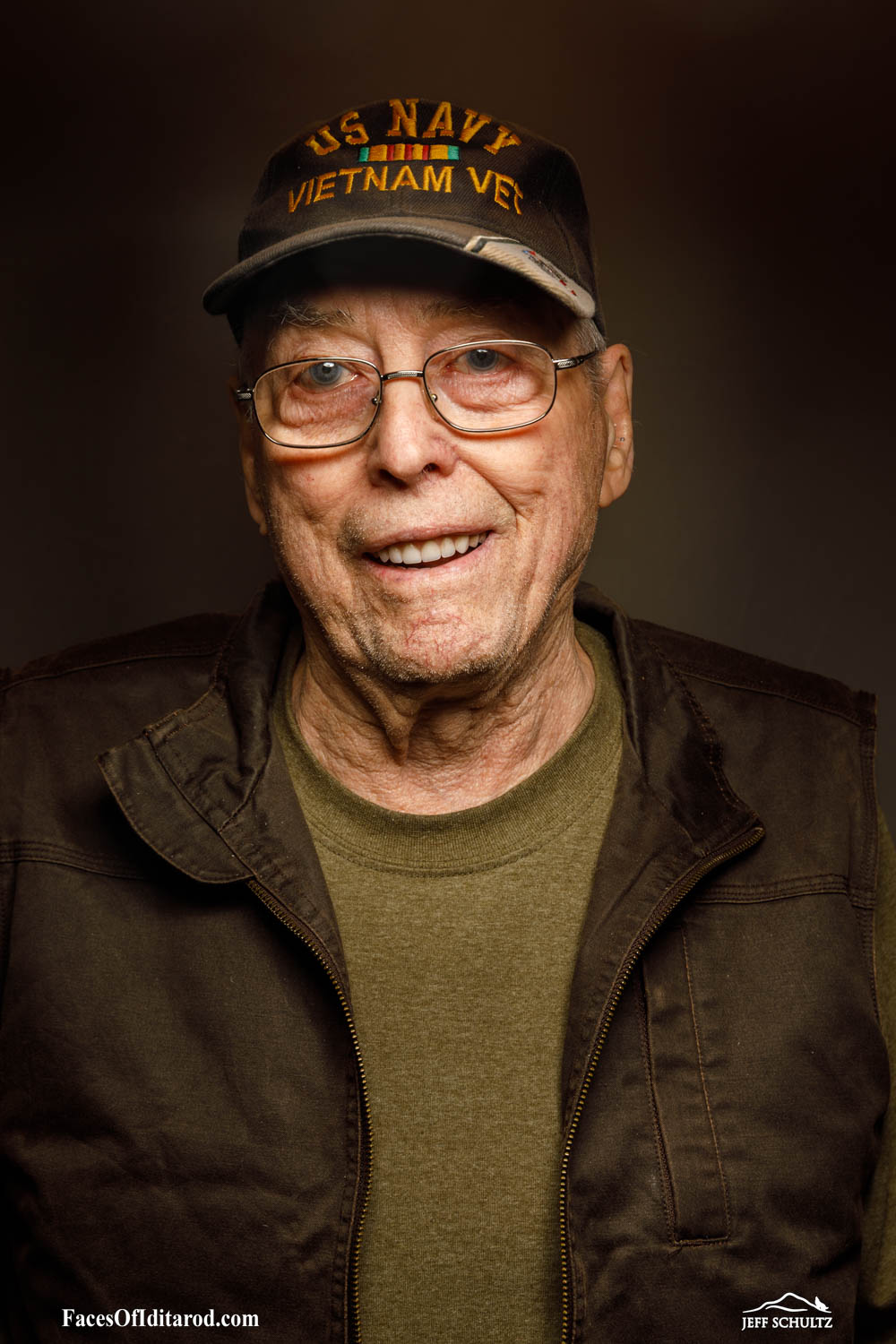
HUMAN
Name: Ray Dronenburg
Age: 89
Residence: Anchorage, Alaska
Occupation: Retired environmental engineer & postmaster for villages in Western Alaska
First Year Ran Iditarod: 1983
Iditarod Role: Musher
Current Location: Anchorage, Alaska
Date of Photo: December 27, 2025
Temperature: 68F inside
What is/was your first and continuing motivation to run sled dogs?
First motivation to run dogs in the Iditarod, I was living in Barrow and a guy came through who had finished the Iditarod. I can’t think of his name. Great big guy. He probably weighed 200, oh, well, over 200 pounds. But he finished the Iditarod and he decided to run his dogs all the way up to Barrow and sometime on the ice. I can’t think of his name, but anyway, he showed up in Barrow.
And I kept thinking the whole time, “Well, heck, if that great big dude can run the Iditarod, I can do that. ” And I had a friend by the name of Steve Rieger who also ran the Iditarod in ’83, and he and I kind of teamed up. And this guy that ran the Iditarod had lived in Willow, and so he invited us to his house ’cause he had a bunch of dogs there. And so Steve and I went there and spent a weekend with him talking, and kind of ran dogs and that started the whole thing.
Continued to run dogs because it just got in my blood. So after, it was kind of fun. But when you first start as just a little sprint teams and running around dogs, training, helping somebody else train. But then it got a little bit more violent, and so then we had to decide… By that time, my wife and I had lived there in Willow, and so we had to buy dogs. And there were a couple of people around at that time that were selling dogs, and we bought some dogs and they didn’t work out.
And we bought more dogs and the grocery bill just kept going up and the vet bills kept going up, but it was just great ’cause Willow was a beautiful place. We could just drive. We bought a house in Willow so we could drive dogs right out of there and go up to almost anywhere. So it just worked out so we just stayed with it.
Question 2: What, who or how and when & why did you first get involved running the Iditarod?
Like I said, Steve and I both had decided we were going to try and run the Iditarod. And that’s an easy statement, but then after that, developing dog team, buying dogs’ sleds, had to learn about sleds. And the truth of the matter was that when we met this guy up in Barrow, I had just come from California. I was a California highway patrol officer and I got a job with the Naval Arctic Research Laboratory in Barrow.
So, I didn’t know anything about the Iditarod. I knew absolutely nothing, and then talking to this guy… And my life has always been something after 12 and a half years in the United States Navy Submarine Service, working as a California Highway Patrol officer, hell, there wasn’t anything more exciting than trying to drive a dog team 1,200 miles across Alaska. So it just all fit.
Tell me about just one of your most memorable experiences running the Iditarod:
Most memorable experience running the Iditarod was, of course, with Libby Riddles when we were kind of closed in up at Rainy Pass Lodge, and everybody was excited about going on, but nobody really wanted to go out there because it was really nasty so you had… I think every team on the tour that year was stuck at Rainy Pass.
And the problem was, of course, feeding, and that’s what I said was. I broke out a big bag of dog food that happened to be the turkey gizzards, and that’s where we sat there. But I was sitting on a bench there at Raining Pass Lodge, and Libby was sitting right next to me eating a peanut butter sandwich, and she turned around and she looked at me and she says, “All right, which one of you guys got the balls to go out in this storm with me?” And we all turned our heads and kind of kept munching on our little gizzards, but I think she found somebody ’cause she took off and won the damn race, so.
What in life do you know for sure?:
Absolutely nothing. When I got out of the Navy after 12 years, I had no life experiences except being on a nuclear-powered submarine. So I didn’t know anything I was going to do, but by happenstance, and I’ll say right out loud, I think God took me and put me where he wanted me to be.
I answered an ad in a newspaper ’cause I actually got out of the navy to go to college, but I knew I had to have a job ’cause I had a wife and a couple of kids. And there was an ad for a California Highway Patrol officer. I entered the ad, and for some goodness reason, I got accepted and I ended up as a highway patrol officer, and that was in 1966. And after that, things turned bad. It’s really a hard job and I had a lot of dead bodies.
But anyway, so then I took a vacation. I was visiting with my mom in Bremerton, Washington, and she came out of the door one time, and I don’t have any clue that anybody knew I was there, but somebody called on her phone in Bremerton, Washington. She called me and she said, “Raymond, there’s an Eskimo on the phone for you. And I said, “Mom, I really don’t know an Eskimo.” She says, “Honest, there’s an Eskimo on the phone.”
I answered the phone. It was a guy who was the primary person of the Naval Arctic Research Laboratory at that time and offered me a job. I swear to God, I have no idea to this day. I can’t imagine how the heck anybody knew I was there. So I went to Barrow. The next day, there was a plane, a Chaika waiting for me. I got on a plane, flew to Barrow. I had an imitation leather coat on. I got out of the airplane and immediately froze and broke all the old little pieces. But fortunately, the guy that came to pick me up had a big jacket that was really warm and it said Naval Arctic Creatures
I was there until 1980 when they closed the lab, but fortunately the Alaska Eskimo Whaling Commission had a problem. They needed somebody to help them solve a problem they had. The International Whaling Commission had put a moratorium on the hunting and killing of bowhead whales, which is the traditional food for the Eskimos. And so Jake Adams, who was the president of the Whaling Commission, came to the lab and I had a meeting with him and he says, “Well, you guys, you’re a scientist. You can help us.” And of course, we didn’t know what the heck he was talking about. None of us knew anything about whales, but we sort of delved into it.
After two years, I ended up writing a scientific paper that’s internationally published, that we presented to the International Whaling Commission, that actually gave them and still gives them to this day, with that report, the information they needed so they could continue to hunt whales. So I’m an internationally published author of bowhead whales scientific. My life just kind of boomed along.
And then when the lab finally closed and the Whaling Commission was doing so well, my wife and I decided to leave Barrow. And no sooner had we left, that the state of Alaska recognized my credentials and hired me as an environmental engineer. And so then after 30 years, I retired from those folks.
And after that, then the post office hired me to be a postmaster in all the villages ’cause I knew everybody from the Iditarod and from just things that I deal with Eskimos. That’s it. I don’t know how to answer your question because I believe that God tells us what we’re going to do. I don’t even know why I’m here. I’m 89 years old and I feel like I’m 70, but he has a purpose for me somewhere, and I think I haven’t solved it yet, and someday I’m going to grow up and know what I want to be when I grow up.