

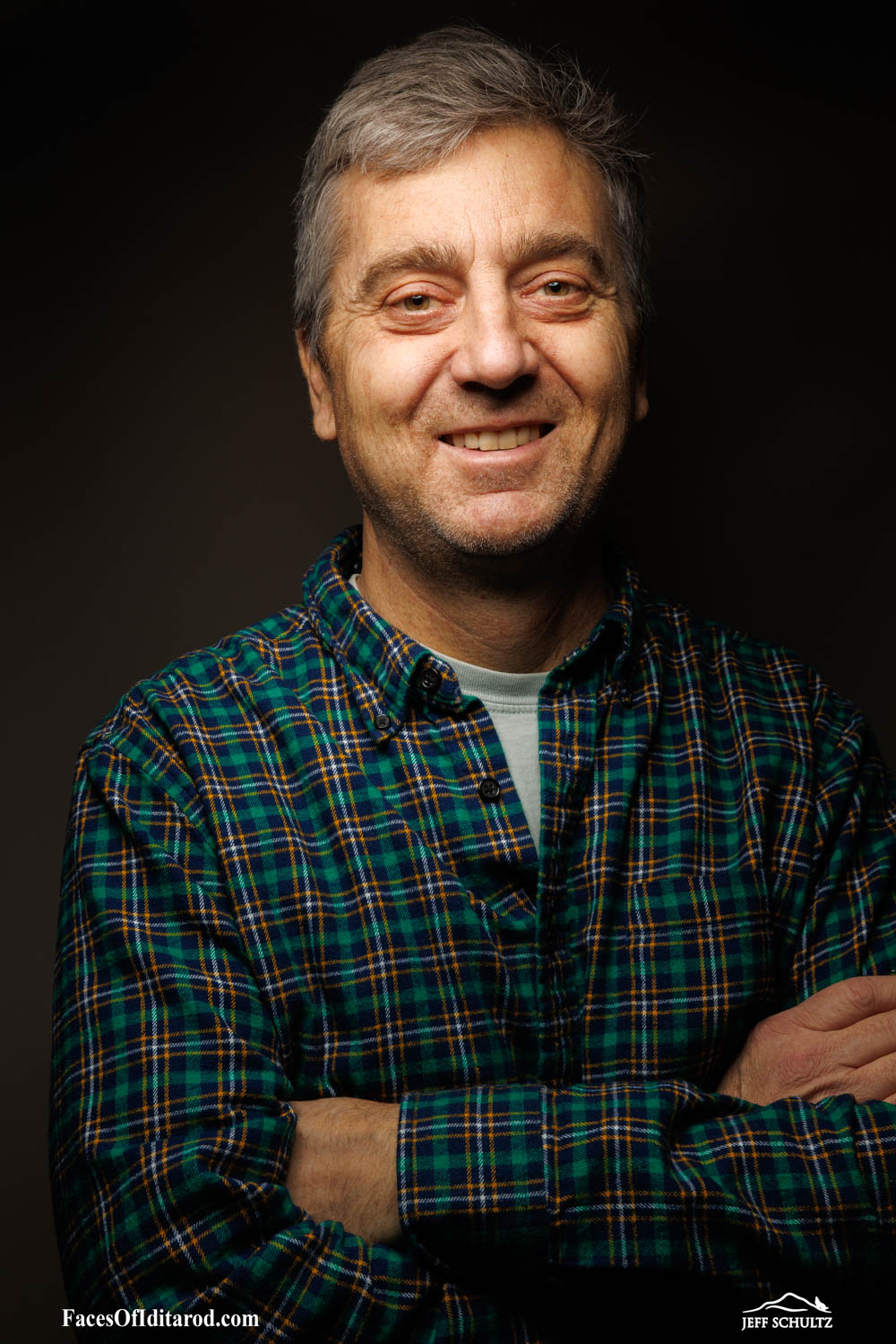
HUMAN
Name: Gunnar Johnson
Age: 58
Residence: Duluth, Minnesota
How many Years involved with Iditarod: Since 1991
First Year Ran Iditarod: 1991
Iditarod Role: Musher
Current Location: Anchorage, Alaska
Date of Photo: March 6, 2026
Temperature: 68F, indoors
Question 1: What is it about running sled dogs that you love so much?
What I love about running sled dogs is I like dogs, I like working with dogs and I just enjoy being around them and being part of a dog… having dogs around.
Running sled dogs is, really, an amazing challenge because there’s so many logistics and trying to organize and pull together and to get 16, even, the first time I ran it, I had 18 dogs, to go down the trail over some really, really difficult conditions is an incredible challenge, and I’ve really enjoyed trying to figure out that challenge.
And there’s a lot to it. And there’s always more to learn. And it can fill your mind with thoughts. You can think on and on about how to do it and how to do it differently and how to overcome certain challenges. And it’s a wonderful hobby. And it’s given me a lot of opportunities over the years. And I really appreciate the sport of mushing and what it’s done for me in my life.
Question 2: What, who or how and when & why did you first get involved running the Iditarod?
So I got involved with running the Iditarod because when I was 12 years old, Jim Lanier came to Minnesota and gave a presentation on his Iditarod, that he ran in 1979, to his friends, which included my dad. And that was really inspirational. It looked like an incredible challenge and adventure and the rugged cold, the Alaskan wilderness and Nome and all these mystical places.
And so when I was 22, 23 years old, I came up to Alaska and I ran dogs from Jim Lanier that Jim Lanier had, John Barron had, Kevin Saiki. I kind of had a mixed bag of dogs and ran the Iditarod in 1991. It took me 22 days. That was a year of big storms and it was really brutal, but I was able to finish. And that’s been a major accomplishment of my life.
I’ve run it two times since. I ran it in 2017 when Jim Lanier had a knee injury and couldn’t run. That year I spent 36 hours trying to get from one checkpoint to another. And then I spent 18 hours sitting out on the Bering Sea on my way to Koyuk. So it certainly wasn’t easy, but I got to Nome that year.
I ran it again in 2021. That year I spent a lot of time. And I really had a really good team that I had put together. We were running an incredible race and pulled into McGrath and were technically in first or right up there at the front of the race. My team was running incredible, they just were roaring down the trail. But of course, I tested positive for COVID and got kicked out of the race. So that was the end of that.
But I have continued to be involved with dog mushing in Minnesota and Wisconsin and in Alaska. And you never know what the future will bring. So thank you.
Question 3: Tell me about just one of your most memorable Iditarod experiences running the Iditarod.
My most memorable Iditarod experience. There’s a lot of very intense highs and intense lows when you run an Iditarod. And one of the experiences or the memories that I have that is really strong is coming over Cape Nome, I did it in 2017. And I had been running kind of behind, following DeeDee Jonrowe and we were together. And we went up over the top. And you look down and you could see the lights of Nome. And you finally knew that you were going to make it or I knew that I was going to make it.
And that was an incredible sense of relief. I mean, there had been many, many points along the way where I was like, “This isn’t going to happen.” And that can be crushing.
And so came over the Cape or over the hill, the mountain, and looked down on Nome and could see the lights. And it was just really exhilarating to come into the finish and all the support of the race and it kind of overwhelms you. So I think that’s the most memorable, positive experience that I’ve got from the race.
What in life do you know for sure?:
What I know for sure in life is, and honestly, I don’t know for sure anything in life. Life has its ups and downs and it’s kind of like the Iditarod. There are high points and there are low points and then there’s just kind of grinding along through every day. And with the Iditarod, what I’ve learned is just to keep putting one foot in front of the other and to keep moving forward.
There are times when things are bad and you might be in the middle of a storm or stuck or your dog’s team is down or you’re down, it’s dark, it’s cold and everything’s falling apart. And what I’ve learned in those experiences from doing dog mushing in Iditarod is just keep moving forward and things will change, and it does.
You might be in a storm, all storms end. It might be dark, the darkness ends and the day comes. And your things may be falling apart, but you figure out a way to keep going and to keep moving forward. And that’s what I know about life, and a lot of that I’ve learned from the Iditarod and working in this sport.