

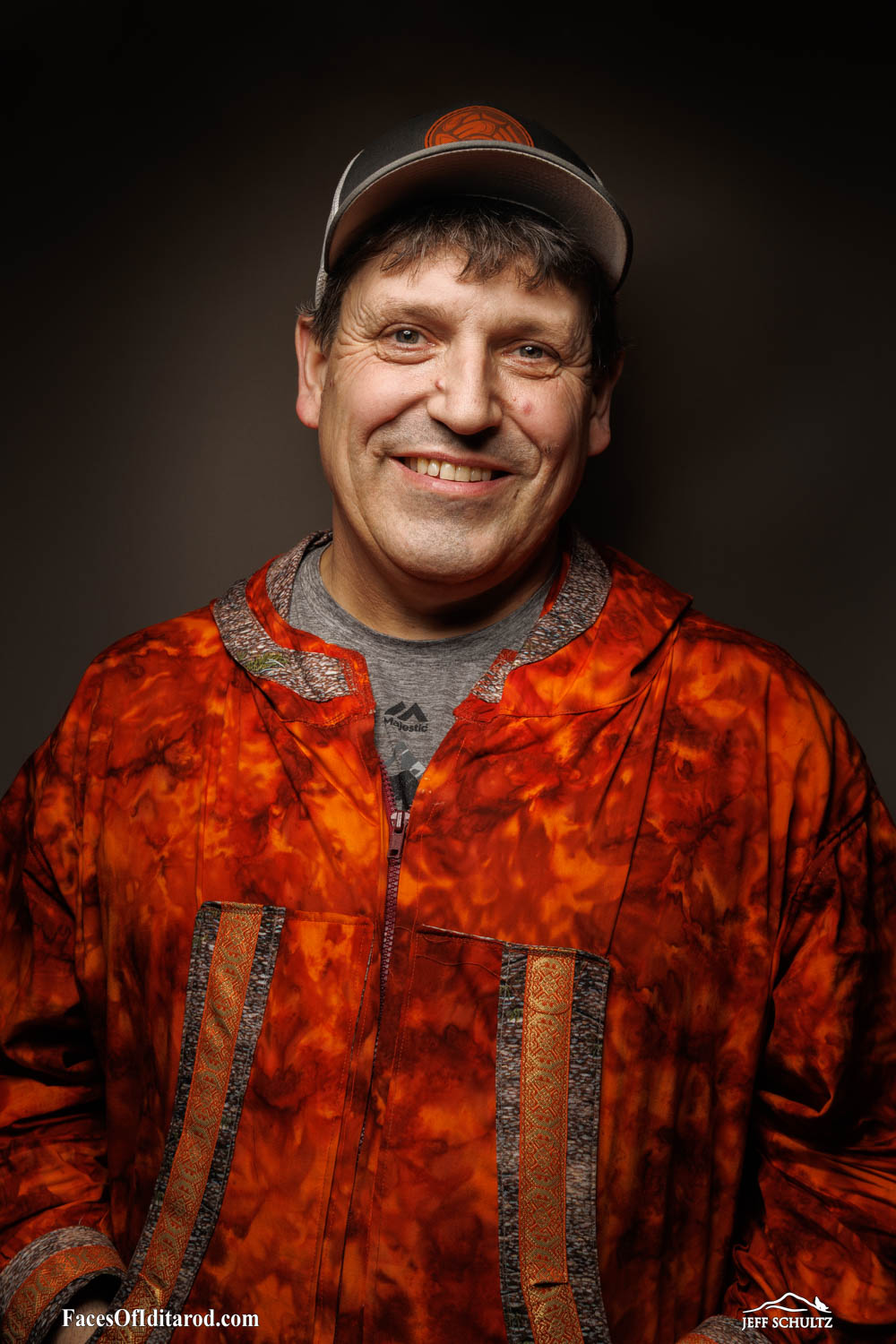
HUMAN
Name: Ramy Brooks
Age: 57
Residence: Fairbanks, Alaska
Occupation: Full-time artist making moose & caribou antler jewelry and sculptures
How many Years involved with Iditarod: 16 years
First Year Ran Iditarod: 1994
Iditarod Role: Musher
Current Location: Anchorage, Alaska
Date of Photo: March 6, 2026
Temperature: 68F, indoors
Question 1: What is it about running sled dogs that you love so much?
What I love about running sled dogs is the relationship that I build with them and traveling, both in the good trails and bad trails, camping with them. And my happy place is out in the outdoors. And the dogs, from the time I was little, we traveled with dogs and I always enjoyed traveling distance with them. Even when I was racing in junior sprint races, we would travel with the dogs to come in from the village and back to fish camp in the springtime.
Question 2: What, who or how and when & why did you first get involved running the Iditarod?
I got involved with racing dogs and running Iditarod probably from the time I was four or five years old. My family ran, were world-class sprint champions. My Grandpa Gareth Wright, my mom, Roxy Wright, and mom ran Iditarod in 1983. And when we were… Mom was training in Rampart for most of the fall, and then we were moving out of Rampart so she could get better training. And my sister and I had a dog team and it was an eight dog team and I kept on complaining my sister was too heavy or something about being in my sled. And so mom agreed to put her in the sled with her. And they didn’t see me until we got to Eureka. And mom always joked that I stole her dog team. So that was one time when we were traveling with dogs and I loved traveling with dogs.
And then when I stayed running sprint mushing through the time, I won every class of the junior North American and won the seven dog. But then at that point, I didn’t think I ever wanted to do anything with dogs because they were always causing me not to be able to do things with other kids as teenagers. And so then I left Alaska, joined the Navy. And I came home after being away from Alaska for six years and mom asked me to run a team of puppies and it just hit me how much I missed Alaska. I missed our way of life. And so grandpa came out and grandma had come out for Christmas dinner at mom’s house. And grandpa was talking about he wanted somebody to run his dogs in Iditarod. And I was committed to… I was in the process of becoming an officer in the Navy, but I said, “Well, I would love to do it. I miss this.”
I said, “Well, I’ll see what I can do when I get back to Seattle and I’ll talk to my commander.” And I asked him, “Could I put in for a sports leave of absence to come home to run my grandpa’s dogs in Iditarod?” And they were like, “Well, one year leave of absence for sports is usually doable, but two years is unthinkable usually.” He said, “But you’ve been a 40 sailor, let’s see, you can put the application in and I’ll put my approval on it.” And so I went through the process and they sent it off into Washington DC and the secretary of the Navy signed it and said, “Approved.” And so I came home in 1993 because I told them I needed at least two years because I had to qualify for Iditarod. I came home in 93 and I had to run a qualifier to run the Quest and I was going to use the Quest as a qualifier for Iditarod.
And so I got qualified for running the Quest and I got through the Quest and things worked out where there was downsizing in the military at the time and they gave me an option right before I came home that I could either stay and become an officer or I could come home to run Iditarod and I came home to run Iditarod.
Question 3: Tell me about just one of your most memorable Iditarod experiences running the Iditarod.
My most memorable experience running the Iditarod brings to mind two or three different situations. One was in the 2002 Iditarod early in the race, I had an exceptional team and it was a clear full moon out, aurora going and I was going along and there was a raven out probably 2:00, 3:00 in the morning and it would fly along right over the top of my team and fly out in front of me, land, and then wait till I got to it. And it did that for several hours as I ran through the night. And it was just a cool thing that happened.
And then there’s sad memories too sometimes like we have family situations. I think it was the 1998 Iditarod. I was having a heck of a race running down the Yukon, but before I had left the start, one of my aunts had passed away and my grandpa on my dad’s side had gone into the hospital and I went in and visited him before we headed to Anchorage and I just was having a tough race. And going into Nulato, I had just a heavy heart and it was like I had somebody to talk like I knew precious that he was gone and there was a lot of friends on the trail like Joe Garnie. I know Joe and then because I was ready to quit. I think I came into Galena in maybe fifth or sixth within a couple of hours of the lead and I was ready to just… When I finally got them to finally tell me that my grandpa had passed, I was going to quit.
And I, again, had a nice team, but they convinced me that I didn’t want to quit and I ran the rest of the race with Joe and I don’t think it was Vern. I ran the race a couple of times and had really good times with Vern also, but there was a couple of people that just kept me going and got me to the finish line and I’m always grateful to them. And then another good time was the 2003 Iditarod. The race started out not so good because my dog team got like super sick and we were starting from Fairbanks by the time I got to Galena. I think the dogs just had this bad flu bug and I was like, “I don’t know if we’re going to make it to the finish line.” And it was Galena that year because of the route. We were early in the race and I just said, “I’m taking my 24 and just see what happens.” And I sat there with Lance Mackey and Paul Gebhart and was throwing… I was recalculating my strategy depending on how my dogs came out of there.
I left Galena in 54th place and figured, “Well, we’ll see how the race goes from here. If it takes me four and a half hours to get to Nulato, I think I just got to just back off and just try to get to the finish line.” I think I was into Nulato from off my 24 in about two and a half hours and to Kaltag within five, I think almost a little over five hours from running from Galena and I stopped for my eight hour and then going down to Anvik and back. We got down to Anvik and started doing the head on passes and Sorlie was out in front and everyone I think had kind of forgot about me because I was so far behind and… But by the time we left Anvik, I was up to second place. And as we’re coming head on, everyone was yelling to me, “Go get them, Jeff.”
And I was like, “Well, this ain’t Jeff.” So it was kind of a cool thing because it was like I went from having one of the worst races to having a really competitive race all the way to the end with Robert. And so those are, I guess, three of my most memorable times on my Iditarod.
What in life do you know for sure?:
What I know for sure in life is you’re going to have tough times no matter what you’re doing and you just got to stay positive and never give up. One door will close, another will open and you find opportunities and look for ways to be successful in whatever you do.