

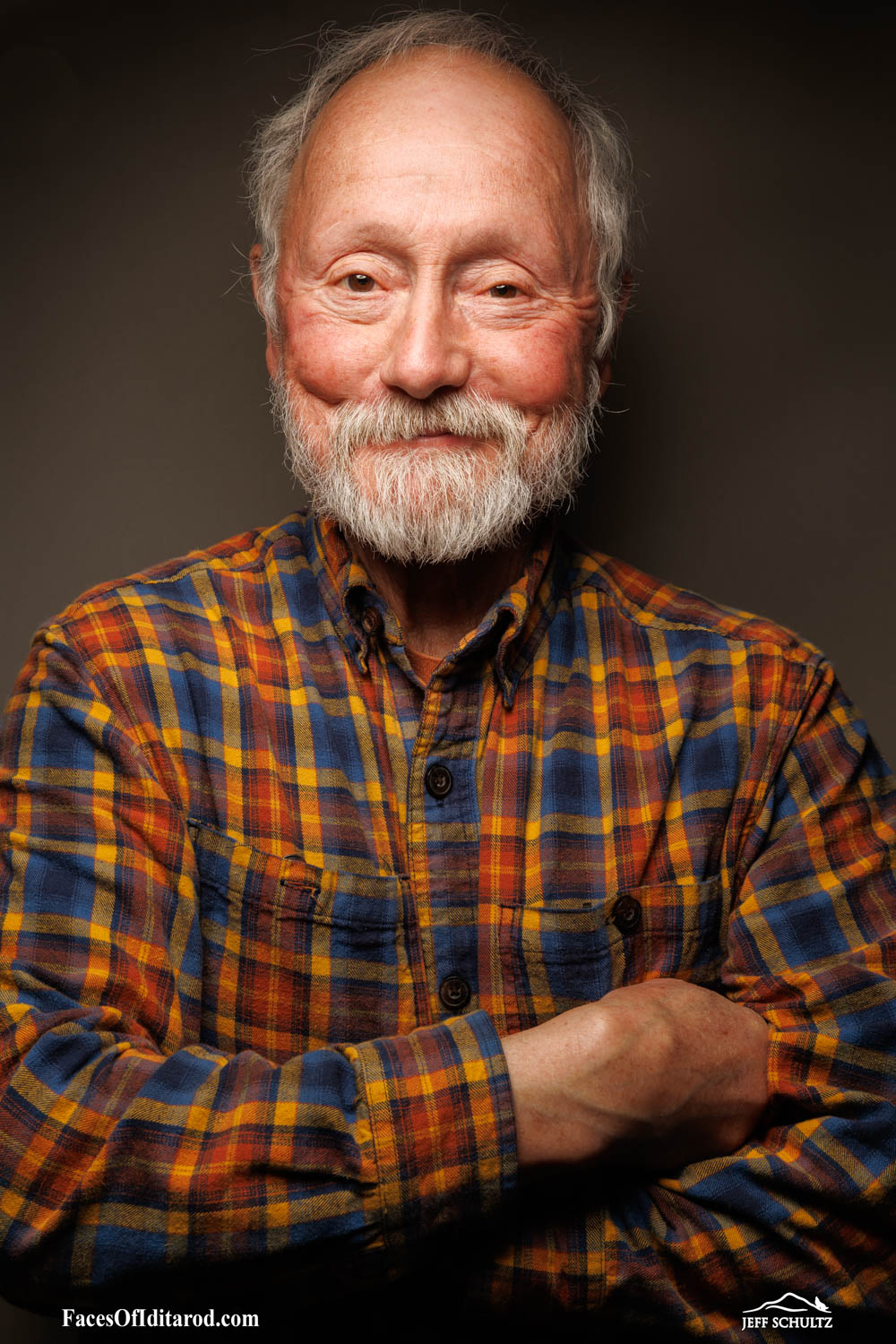
HUMAN
Name: Jerry Raychel
Age: 76
Residence: Sunrise, Alaska
Occupation: Retired
First Year Ran Iditarod: 1984
How Many Years Involved With Iditarod: 5+
Iditarod Role: Musher
Current Location: Palmer, Alaska
Date of Photo: April 9, 2026
Temperature: 64F indoors
Question 1: What is it about running sled dogs that you love so much?
What I love about running sled dogs has been the adventure, the exercise actually kept me out and kept me busy during the wintertime, and that’s been great. I made a lot of friends in the sport. Got a lot of joy out of that. I got to see a lot of country that I wouldn’t see. It’s been really great and I’m, I’m happy I did it. The dogs, dogs were terrific. It was fun. Their enthusiasm was catching… the way the dogs love to run. A lot of people don’t understand that they just love to run.
Question 2: What, who or how and when & why did you first get involved running the Iditarod?
I got involved with running the Iditarod on kind of a short development period. When I moved to Alaska in 1974 I had no thoughts of sled dogs. My first years up here, I took to cross- country skiing. And one week, some friends and I were skiing through Resurrection Pass and we ran across a guy with a pulka. Pulling his camping gear while we were backpacking ours. I said, that looked pretty cool. So I got one dog. Next year, we were on another camping trip on Petersville Road, and a guy come at us with two or three dogs, skijoring. I said, that looks pretty cool. So I had my dog bred. And then, another year or so after that, I had four or five puppies, and I tried skijoring with, like, five or six dogs. Didn’t work, so I had to get a sled. I got the sled, and it was built by Barve— one of those big plastic sleds, and six dogs was hardly enough for that, so I got a few more. And then I had that many dogs I might as well run the Iditarod. All that took place in a couple of years. I’d been running in shorter races at Chugiak, in Montana Creek, and I met some, Iditarod’s there, Steve Flodin, John Wood, and that kind of helped me get prepared. So I ran some mid distance races up at Montana Creek, and by 1984 was ready to do the Iditarod.
Question 3: Tell me about just one of your most memorable Iditarod experiences running the Iditarod.
Some of my most memorable experiences on the Iditarod— First, I think it was the 1st one– they kind of all have blended together a little bit with time. But we were running between Rohn River and Nikolai and the trail was wet. It was warm and wet and we were going there was just a ditch through the brush, and the dogs were trying to jump in the brush out of that, out of the water. And we got to Farewell Lakes. And when you got to the lake, if you didn’t know better, you’d think it was just wide open because it was completely covered with water. And all it was out there was the tripods. And I thought, oh, this is gonna be tough. But the dogs, I gee’d and haw’d them like I was driving a boat through that stuff. They did great. They followed the tripods, and that was pretty cool.
Same kind of thing— Training down here in Southcentral, we don’t get the coastal winds and that kind of weather. When we got up on the coast it was always kind of a learning experience for the dogs and I. But when they once they got it, it was really fun to watch them— watch them pick up the scratches on the ice as the trail. And in a ground blizzard, look for the stakes ahead and pick those out one at a time, because that’s all you could see and have them steer to those. Once they figured it out, it was just really, really cool.
And one last thing. This is my first year at the banquet. And the banquets were always fun but everybody’s given these long speeches and telling their stories, thanking all their sponsors, and they went on and on. And it finally came time for the last one, which was Dean Osmer that time. He got up, and he said; “Thanks”. And that was the whole speech, and it was the best one I ever heard.
What in life do you know for sure?:
What I know for sure in life is that you gotta work to live, not live to work. Unless you’re lucky enough to have a job that does both. So get your money from your job, and get out there and enjoy life, and do the things you want to do, whether it’s dog mushing, or fishing, or hunting, or whatever it is. Don’t worry about working, ’cause you only got so much time.