

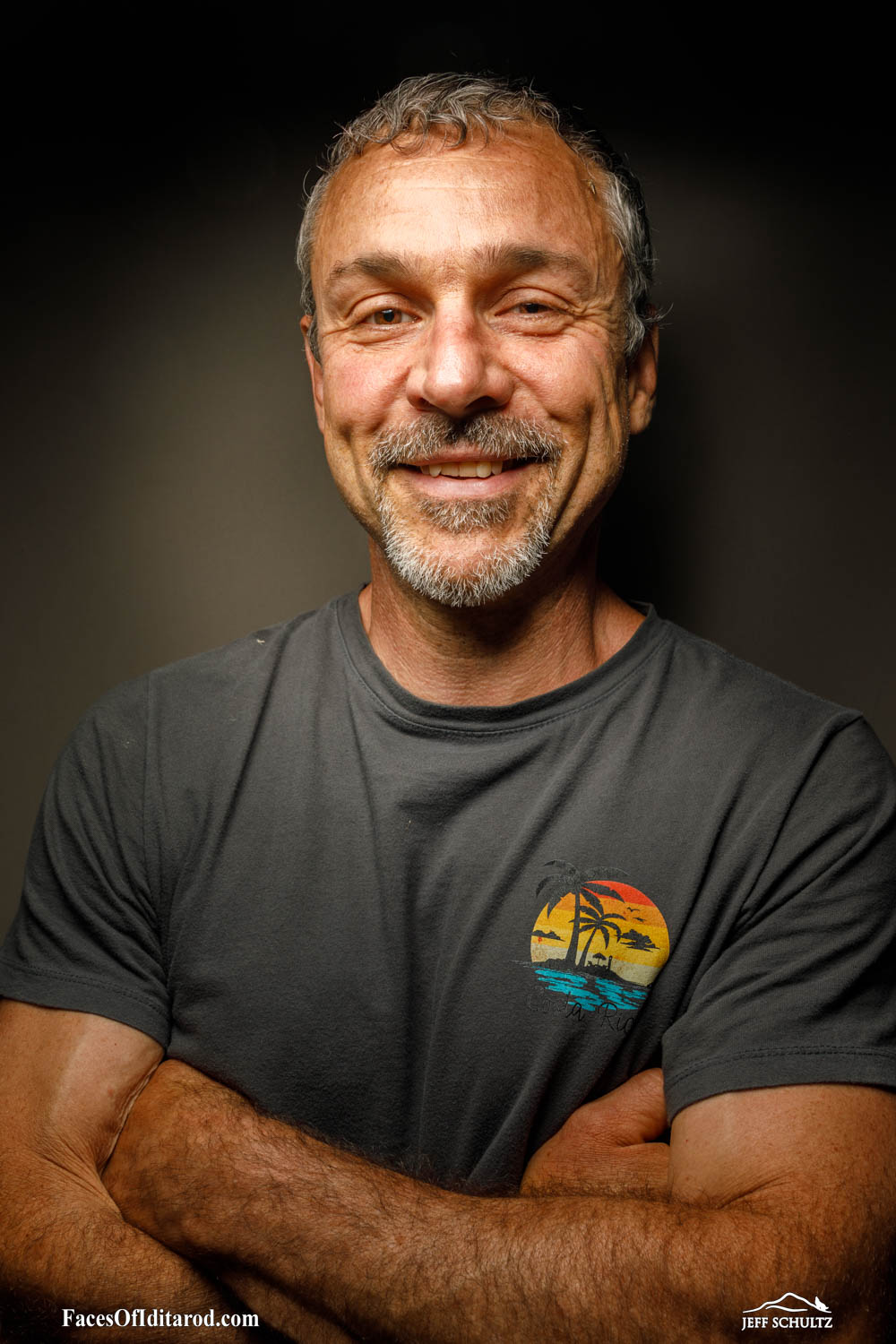
HUMAN
Name: Will Rhodes
Age: 48
Residence: Two Rivers / Pleasant Valley, Alaska
Occupation: Professional Geologist & Environmental Engineer
First Year Ran Iditarod: 2024
How Many Years Involved With Iditarod: Since 2001
Iditarod Role: Musher, handler
Current Location: Fairbanks, Alaska
Date of Photo: June 21, 2026
Temperature: 70F outdoors
Question 1: What is it about running sled dogs that you love so much?
What I love about running sled dogs is so many things of course. But I think the ability to work with an animal in Alaska in the wintertime outside and enjoying every part of winter from the onset, before we have snow on the ground, through the fall and sharing that experience with the animal that you’re working to a common goal, eventually typically running a race, at least a race of some sort and really just spending time with the animals and bonding with the dogs and seeing them grow up through the years, raising them from puppies, watching them develop athletically and mentally and physically into adulthood, sharing all that with the animals is incredible.
That’s probably what I love most about running dogs is just working with the animals in the wintertime outside in Alaska. Yeah, it’s great. The structure, too, that they provide in the wintertime, they force you at times to go outside when the weather might be really bad and long stretches of tough time to be here in the state. And you’d be surprised, you’d get out on the trail with your dog team and maybe it’s not so bad. And in fact, you end up having a wonderful day at 35 below. So I just have a lot of good times with the dogs.
Question 2: What, who or how and when & why did you first get involved running the Iditarod?
I got involved running the Iditarod because ultimately I was introduced to sled dogs in 1998 when I was doing a carpentry job in Haines, Alaska for the borough tax assessor. His name was Dan Turner and he happened to have a dog team and it was really unusual for people in Haines to have a dog team. And he was running the Yukon Quest and I was 19. Yeah, I was 19, almost 20. Anyway, so he asked me at one point, “Would you be interested in being a handler for me for this upcoming winter? I’m running the Yukon Quest.” And, “What’s that entail?” And he’s like, “Well, you can help me train the dogs and shovel poop and cook dog food and cut meat and run the dogs and live in a small cabin in the Southern Yukon territory with no running water or electricity. And you’ll have a great guy to hang out with. He’s the 1980 Iditarod champion. His name is Joe May.”
And I’m like, “Huh, you know, what the heck?” I was uncertain about whether or not I’d go to college that following winter and decided to just take an entire year off and I took him up on the opportunity and spent that winter in the Southern Yukon and a couple of months with Joe May learning how to run sled dogs, feed sled dogs, keep sled dogs, be in the wilderness in the north. I’m from Northern California, so I’d never really spent any time in the snow during the winter, you know, periodic trips up to the mountains or whatever. But yeah, so that’s ultimately how I got involved with sled dogs. And a couple summers later I was working for a tour operation on the Juneau Icefield and met my now-wife, Brenda Mackey, and she convinced me to come see Interior Alaska.
And so I hitchhiked up here to her house that summer and ended up going to school here at UAF and Brenda and I eventually got married, have a wonderful daughter, and started our kennel in 2011 together. And her dad and her grandfather and her uncle, a couple of her… Well, I don’t know, however many Mackeys there are who have ran the Iditarod. So yeah, it was ultimately a goal of mine to at least once, get down the trail and see it more from a life experience and historical perspective than anything else was really my interest in running that race.
Question 3: Tell me about just one of your most memorable Iditarod experiences running the Iditarod.
So my most memorable experience running the Iditarod is leaving Old Woman Cabin and running my dog team onto the village of Unalakleet. So that was an incredibly memorable run for me because, well, I was most excited, I guess pre-Iditarod and getting to the coast and running my dog team down the coast and seeing the landmarks on that stretch of trail and the geography and the villages and the people. But it was a really cold night before coming into Old Women Cabin. I mean, it was at least 50 below zero and it was a pretty tough run to get there. And when we left Old Woman pretty early in the morning, it started to warm up and the sun came out and you could eventually see the ocean in the distance and just the scenery and the temperature and the point I was in the event.
It was just an overwhelming experience to be on that section of trail emotionally and my dog team looked great and they were just cruising and it felt easy, you know? And yeah, it was just my most memorable section of trail to be on really because we were getting to the coast and the back end of the race and finally there. So a lot of hard work to get there and it was a long time coming, I guess it felt, it was just a beautiful, perfect entrance to that.
Question 4: What in life do you know for sure?
What do I know for sure in life? Hmm. I don’t really know anything for sure in life. What do I know for sure in life? Well, yeah, since we’re on the topic of sled dogs, what I know for sure in life is I will continue to run dogs here as long as I live in Interior Alaska in an area where I can run sled dogs, I will do that as long as I can because I enjoy that so much. It’s a priority for me and really I’ll do whatever it takes to make that happen for as long as possible. And I think the limiting factor for people is old age, orthopedic issues and such because it’s a lot of hard work. So just really work hard to keep myself able to do that for as long as possible. So that’s what I know for sure in life is that I’m not ready to stop doing this anytime soon.