

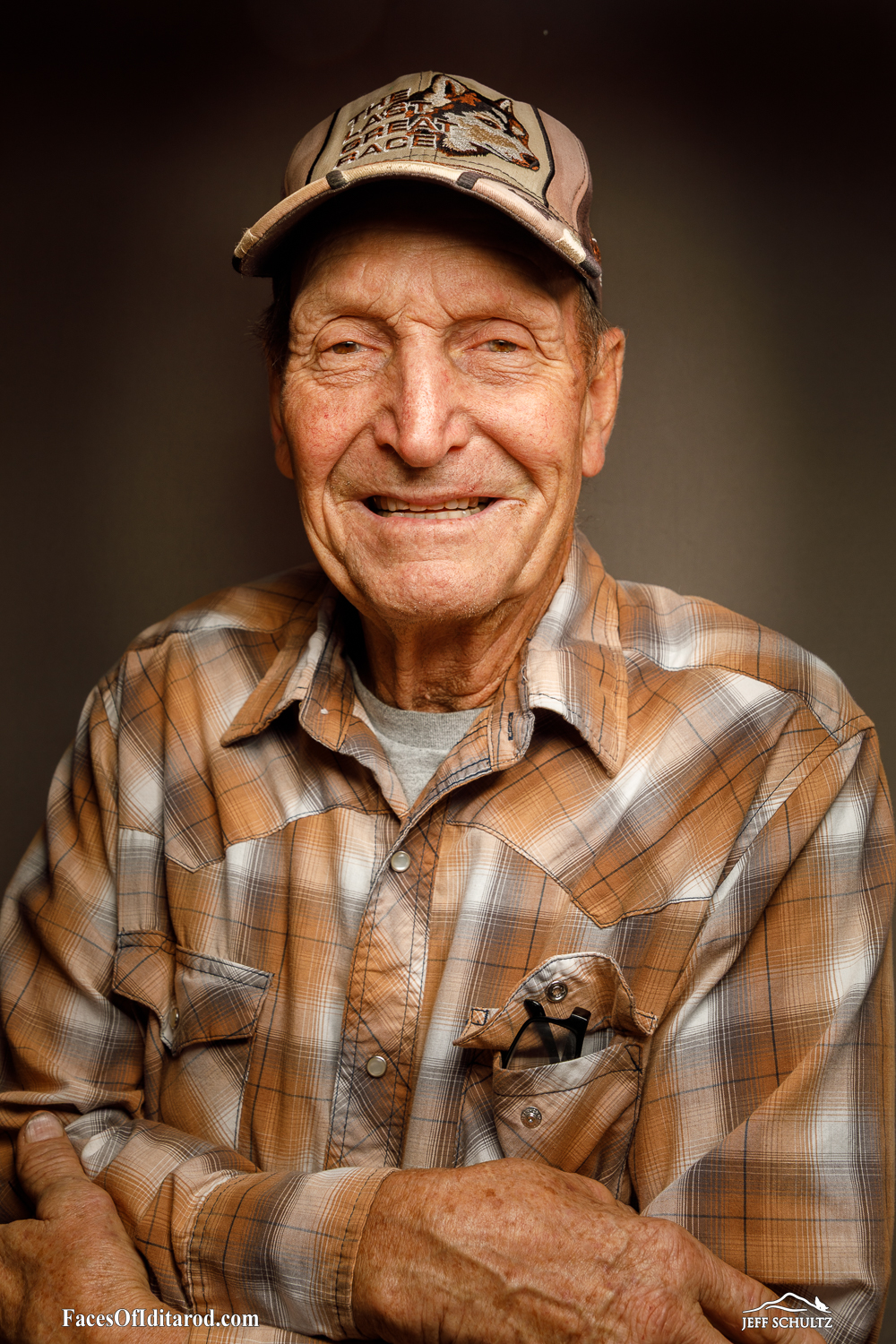
HUMAN
Name: Dave Olson
Age: 79
Residence: Big Dry Creek, Glenwood, New Mexico
Occupation: Retired Concrete Mason
First Year Ran Iditarod: 1973
Years involved with Iditarod: 4 years
Iditarod Role: Musher, trail breaker & clearing the trail before the 1973 race
Current Location: Big Dry Creek, Glenwood, New Mexico
Date of Photo: January 23, 2026
Temperature: 56F
What is it about running sled dogs that you love so much?
What I love about running and having sled dogs is just the peaceful solitude away from everybody and enjoying life, I guess, seeing the country, and exploring, and stuff. And the way I got into sled dogs was a friend in high school went to work on a ski lodge, Northern Minnesota that year. And we lived in St. Paul. He come back with two sled dogs. And there was a dog club named North Star Sled Dog Club that was pretty much Siberian Huskies at the time. And we just had no registered dogs, but I helped John gather some of the Siberians from friends in that North Star Club. And we started running dogs, little wheel carts in the summer. The Minnesota State Fairgrounds had big agricultural fields behind it, and we’d go up and run the dogs around there on a wheel cart.
And then the wintertime, we had found a friend that was in that club that lived in Wisconsin. He invited us over and there were three of us, John Weber, myself, and then we … Anyway, we all were running dogs, and the friend in Wisconsin invited us over to run. He lived on the Chippewa Flowage, I think it was, they called it, if that’s the right name. Anyway, he had a little cabin, and his wife, and two little kids at the time, and we’d go for the weekend and we’d sleep on the floor in the cabin and run through the woods down to the lake, and around the lake, and come back to Minnesota, and do our things there, and train.
And we finished high school with the dream of going to Alaska, all three of us together with dogs. But the Army got in the way of that and drafted two of us. And the other one that started us with the dogs, John Weber, he enlisted and went into the Army, became airborne and shipped to Vietnam. And I ended up being in Vietnam and our other buddy ended up in Germany. And the thing about it, when we got together in high school, he was born on February 3rd, same year I was, ’47, and he was in St. Cloud at the time when he was born. I was in St. Paul. And however we got together, his dad was a fire marshal in St. Cloud and they hired him to come and be the state fire marshal in Minnesota at the time. So they moved to the Cities in St. Paul. And he went to our high school. That’s how we got started together, running.
Question 2: What, who or how and when & why did you first get involved running the Iditarod?
I got involved running the Iditarod because when I came back to Alaska from meeting Joe, he invited me to his dog lot with my dogs and I could stay in his dog lot. So I pulled a little camp trailer with me, and my dogs in the dog box, and ended up in Knik, where Joe was living and started running dogs from there. And his dream, they had an Aurora Dog Mushers Club formed at the time. And there was a handful of guys that had school teachers and other guys that had sled dogs in the area. And we’d have a meeting once a month, and the Iditarod would come up every meeting, almost. Joe was living in a little cabin in Knik, little log cabin, him and his wife, Vi. And we’d have the meetings there. And then we went to Dorothy Page’s place in Wasilla and had meetings there.
And as time went on, Joe and I would go out the Iditarod, training dogs and stuff, and then make trails around our area of Knik. And he said, “We’re going to get this Iditarod going.” He got a hold of the Army in Fort Richardson. J. Paul Getty, I guess, was a general there at the time. And I can’t remember, it must have been the early summer or something, but Joe says, “Maybe we can get the Army to have a couple of squads, or a platoon, or whatever out on snowshoes and skis, and see how they winter train.” I can’t think of the name, “Do a mission or something.”
And so lo and behold, the next winter we got, that was ’72, I believe, that we went out to Old Skwenta Crossing, the helicopters, dogs sleds, and their barrage of Army guys, all their equipment, tents and stuff. And we started up the trail and looking for markings. And they’d go ahead and help break trail a little bit. And then where we could, we’d go ahead and break trail, and looking for slash marks on trees, and made it up past Finger Lake and come to Happy River. And I was leading the thing. I’d come to the bluff of the river and nowhere I could go. So I just sat there and waited because they were moving the Army guys to Shirley Lake. It’s just across the Happy River. And so we made camp there. And then I guess there was another group that came from Rainy Pass area and down, got to the Rainy Pass Lodge and stuff.
And the first couple of years the Iditarod ran, they had to go through Hell’s Gate, they call it, go down the South Fork of Kuskokwim because Rainy Pass was too much snow and they couldn’t break trail to get through there. So the first couple of years went down the South Fork to Rohn River, and then Farewell, and then over to Nikolai. So it was a little tough, but the guys that broke the trail, it was more or less Frank Harvey, Jay Peterson, Gene Leonard, Joe Delia, those were the guys that lived out in the area where the Iditarod went through most of it.
Tell me about just one of your most memorable experiences running the Iditarod:
Well, my years of running the Iditarod was ’73 I started, but I had bronchial pneumonia, and had to scratch out of Knik, go back home. But then the last year I ran the Iditarod, I tied up with Deedee Jonrowe, Sue Firmin, Rick Mackey, and Gary Whittemore out of Cantwell. And we were all having troubles, so we banded together and finished the race. One way or another, we were going to go. So we ran into a few challenges going into Iditarod. There was the creek running and we couldn’t get the dogs across. So I was with Sue and Deedee. So we had to cut a bunch of spruce boughs and pile it up, shovel snow on it, and we got across that to get to Iditarod. And then we picked up Rick Mackey and Gary up on the Yukon, I think. And from there we went to Unalakleet, and across Unalakleet that year, they didn’t have a trail over the land, so we went across the shoreline, and there was a lot of open leads, and this and that you had to be careful for.
And towards evening we were getting close to Shaktoolik, and the wind came up, blowing, so we all decided we’d just hole up right there and just slept with our dogs, curled up with our dogs and waited ’til morning, and the wind subsided, and we got out of our gear and stuff, and looked up, and there was Shaktoolik, just not too far away. So that was one of the worst Iditarods I had, other than the experiences that I loved doing.
What in life do you know for sure?:
Well, what I know for sure in my lifetime, it’s pretty much getting together with a friend in Minnesota, but getting into the sled dogs, wanting to live our dream, go to Alaska, which, out of three of us, two of us made it and one didn’t, but the life I had in Alaska, I don’t think I could have experienced any other better life than having sled dogs and great friends.