

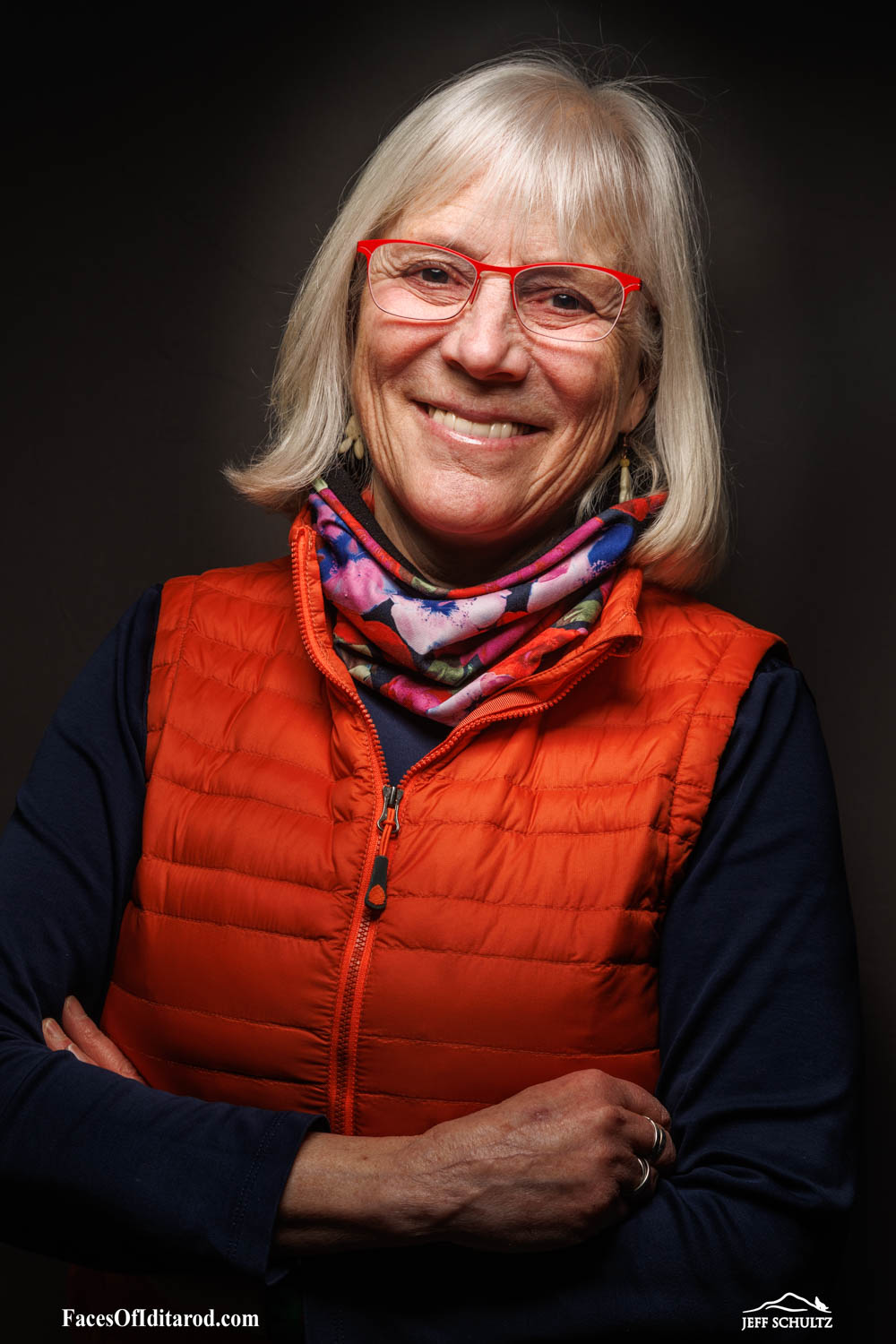
HUMAN
Name: Debbie Moderow
Age: 71
Residence: Anchorage, Alaska & Denali Park, Alaska
Occupation: Author
First Year Ran Iditarod: 2003
How many years involved with Iditarod: Several
Iditarod Role: Musher, volunteer, mother to Junior Iditarod Mushers
Current Location: Dena’ina Convention Center, Downtown Anchorage for Musher Banquet
Date of Photo: March 5, 2026
Temperature: 68F, indoors
Question 1: What is it about running sled dogs that you love so much?
What I love most about running sled dogs is the fact that to run sled dogs mean you’re living a lifestyle with sled dogs. We centered our family around a small and growing team of sled dogs for many, many years, several decades. And we learned a tremendous amount from those dogs. Our first dog was a retired Iditarod husky. He taught us all about resilience. He showed us the wilderness trail. He became a leader to a couple of puppies when our kids wanted to run. And we then learned about group dynamics among dogs and also among our family.
Resilience, patience, overcoming challenge. It’s all been an incredible joy to run these dogs and center our lives around them. And I feel like I am still becoming a better human, having spent so much time in the company of these amazing animals.
Question 2: What, who or how and when & why did you first get involved running the Iditarod?
I first became aware of Iditarod soon after moving to Alaska in 1979. I had to see the dogs that were going to go across the state of Alaska. Went to some early starting lines and did take note of my husband Mark’s good friend, Vern Halter. When he started Iditarod in 1983, they were law school buddies together. And I just couldn’t get it out of my head that these were working dogs that had everything to do with the history of Alaska and a tremendous amount to do with potential adventure going through the state.
I got involved running Iditarod. I had been mushing for 15 years when my son Andy finished Iditarod. And under the Burled Arch he said to me, “Mom, you have to do this.” He had run Martin Buser’s second team. He was about to go to college, so was his sister, and that was going to leave 20 dogs in our backyard. I had always been a mom first and a trainer of the dogs first, but I thought, “Wow, I’m so lucky to have this chance. How can I not at least try?” And that’s when I decided to run Iditarod.
Question 3: Tell me about just one of your most memorable Iditarod experiences running the Iditarod.
My most memorable experience running the Iditarod was when I passed through Safety on my second Iditarod attempt. I did not finish the race on my first attempt. We were going up and over Cape Nome. It was sunrise. My dogs had on red jackets and they were hitting stride like there was nothing better in the world than to be running towards the Burled Arch in Nome, which I really had feared for many miles we might not get to. So I was thrilled. It was a very special moment.
What in life do you know for sure?:
What I know for sure about life is that change is a constant. If anything taught me that the best, it was my experience on the Iditarod Trail. Everything can be just glorious, romantic, easy, forward moving one minute, and then the reverse happens and you’re faced with an enormous challenge that you’re not sure you can get through.
I feel like our sport, the lifestyle and the race right now is at one of those points of challenge. Climate change alone threatens the future of this race as do economic challenges, logistics in urban areas of Alaska. There are many, many hurdles that Iditarod needs to address. And one thing I know is I’ve learned from the dogs to take one mile at a time. They do that better than the human, I think, because it’s always a push to try to focus one mile at a time.
But I think where the musher comes in, when they’re at their best is when they have a view on the long haul on the horizon line. And I hope the leaders of Iditarod in this present juncture in time have their eyes on that horizon because I think there’s a rough trail ahead. And I feel so grateful to have done this and so hopeful that my grandchildren might be able to do it or their children in the years ahead.