

HUMAN
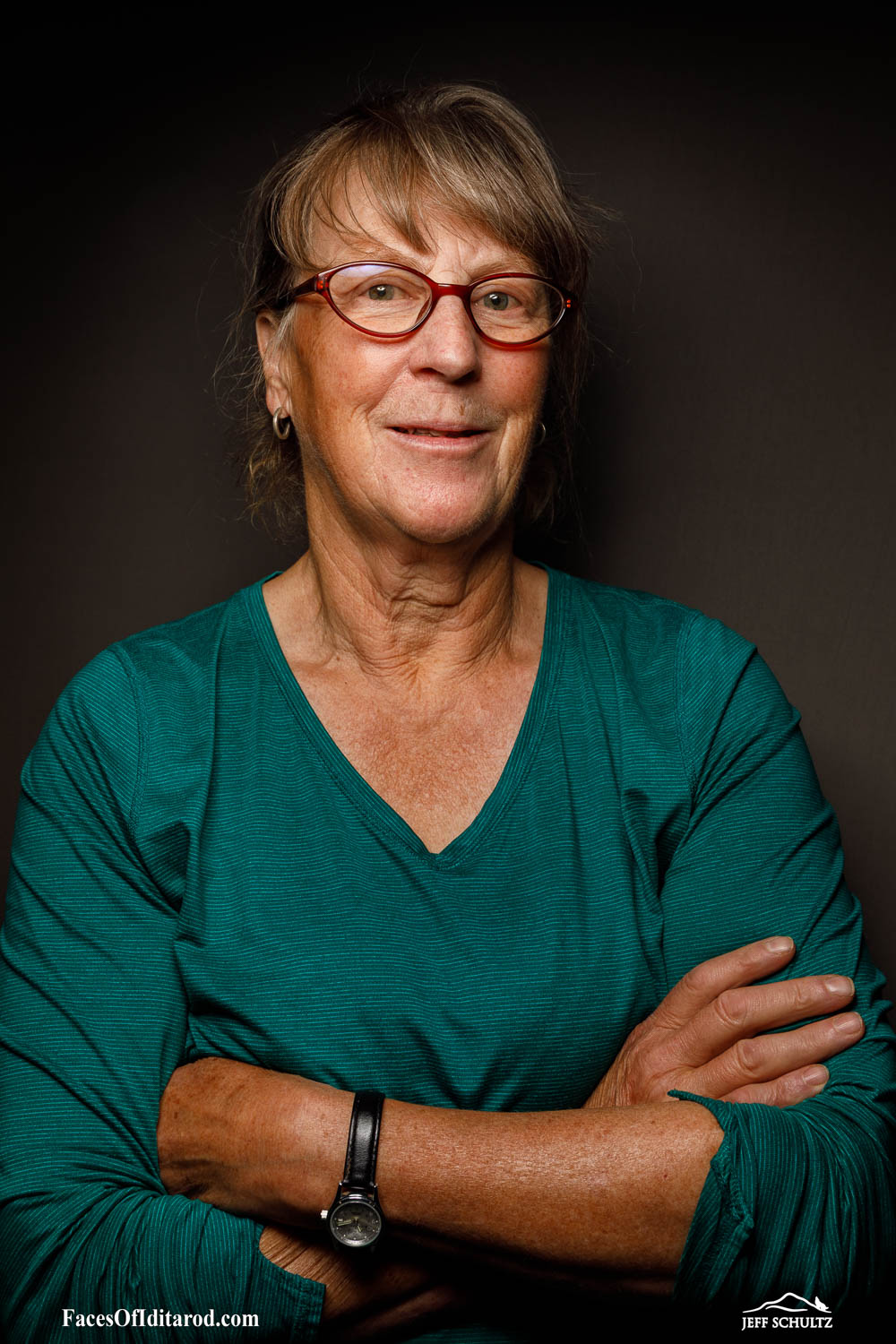
Name: Kirsten Bey
Age: 70
Residence: Portland, Oregon
Occupation: Retired State Public Defender, retired fabric shop owner and retired recreational dog musher
First Year Ran Iditarod: 1993
How Many Years Involved With Iditarod: 33
Iditarod Role: Musher, volunteer, musher’s host
Current Location: Palmer, Alaska
Date of Photo: August 28, 2026
Temperature: 65F indoors
Question 1: What is it about running sled dogs that you love so much?
What I love about running sled dogs is being out in the country with the dogs, just watching them work, it’s really hard for me to even just talk about it, it’s such a wonderful opportunity. Just seeing country that a lot of people never get a chance to see, being behind the sled, watching the dogs do what they love to do, being dependent on the dogs. I can take care of them to a certain extent, but then I really depend on them to take care of me, and if they do take care of me, that shows that I’ve taken care of them. I know when I would run in Nome, I wouldn’t even be able to describe the colors of the sunsets and sunrises, I would often think about, if I was going to tell somebody what colors am I seeing, I wouldn’t even have words for them, the purples and the pinks and the blues, and you just get to see a lot of stuff that the regular person doesn’t get to see.
Question 2: What, who, how and when & why did you first get involved running the Iditarod?
I got involved running the Iditarod because I had the wonderful opportunity to be a dog handler for Vern Halter, and the story of how that came about is really incredible. I had gone to law school at Northeastern in Boston and two of my best friends from law school had moved to Nome. And in 1990, I was working as a lawyer and I needed a break, and so I quit my job, took the summer off. The last month of that vacation was coming up to Alaska to get together with my friends Scott and Mary. And they were public defenders and there was a public defender annual conference in Valdez, and I took the ferry out there to meet up with them and the weather got bad and no one could fly home. People were looking for rides, and my friend Mary had driven and Vern Halter ended up riding in the car with her back to Anchorage.
And we got to talking and, “what’s your story?” “I’m looking for any reason not to go back to work.” And Vern’s wife, Susan, was just starting vet school that year, so he didn’t have a handler, and so he said, “well, if you’re interested in handling dogs, taking care of dogs for me, we could probably work that out.” I had never even thought of anything like that, I had been bitten by dogs a couple of times, I was afraid of dogs. I thought, well, they’ll be like cows, you just feed them and they’re tied up, whatever, and I ended up doing that and I just loved it. Well, I needed that break from being a lawyer, and so just doing good, hard physical work, I really liked that. I have Norwegian heritage and so I think I have a good inner sense of being in the north. I was born in North Dakota, lived in Montana as a real young child, but never really had any experience being out in the real winter, but I just loved it.
And Vern had 16 pups that year and that was my job to run them. At that time he was going back and forth between his dog lot in Trapper Creek and working as a public defender in Kotzebue and he’d have to load up his dogs in the summer and take them up to Kotzebue. He said if I wanted to stay at the kennel, he wouldn’t have to move his dogs up there, and so I did that. And then I felt like I didn’t know what I was doing that first year, so I thought, well, if I stick around another year, I would at least have some experience. And then as that winter ended, he had these 16 pups that were now two-year-olds and said, “Well, if you’re interested in running these young dogs to Nome in the Iditarod, you can do that.” And it’s like, how do you say no to that?
I feel so fortunate that I had that experience when there are so many people who just dream of running the Iditarod, being a musher, and that had never been anything in my thoughts. But I loved it and by that time I decided I was going to stay. I did get to run his young team to Nome in the ’93 Iditarod, and at that point I decided I would stay, I wanted to be in Alaska because I wanted to get my own dogs and at least be a recreational musher. And so then I took the bar exam and was able to practice law in Alaska and ended up in Nome at the public defender’s office and had just a great experience there.
Question 3: Tell me about just one of your most memorable experiences running the Iditarod.
My most memorable experience running the Iditarod is probably finishing it. Of course, there are so many individual little pieces that we remember and think about, fortunately, you don’t really remember the bad things. I’ve never had a child, but I think people talk about, well, childbirth, you don’t remember the pain, you just remember the joy. I don’t remember any of the bad things of the Iditarod, a lot of the good ones.
But anyway, in finishing, I had borrowed a dog from Connor Thomas who was a musher in Nome, and so she was running home, basically coming into Nome. And when we crossed the Nome River and going out onto the shore, onto the ice where we come into town, I’m going to blame it on the dog, not me, but Cheeks took a kennel club, a Nome Kennel Club trail, which doesn’t go down onto the ice, but it crosses the highway and then goes basically on the backside of Nome to where the kennel club race starts were. There was somebody in front of me who had also done that, so maybe it was his fault. But anyway, several of us were together and we ended up on the backside of Nome.
And we actually were going by Richard Burmeister’s dog lot and he saw us and he knew something had gone wrong, so he jumped on a snow machine and got in front of us and got us all turned down, I think it was Seppala Avenue. So we went about five blocks through Nome on the Gravel street and then had to do a hard right onto Front Street. So we actually did get to Front Street and be able to finish under the arch, but we did not enter the traditional way.
Question 4: What in life do you know for sure?
What I know for sure in life is, you need to be willing to take a left turn where the normal turn might be right to just take advantage of opportunities that are presented to you. My Iditarod story is one that was just such out of the blue, weird coincidence thing, but changed my life. I got involved in late 1990 and I did that for 35 years. Had dogs that whole time, and like I said, that just changed my life. The fact that I ended up in Alaska, the work that I had, how it has allowed me to have a good retirement, just things that you may not have planned for them, but they happen and they’re just things that, just not being so stuck on a certain path, but if a alternate route opens up, check it out and see where it takes you.