

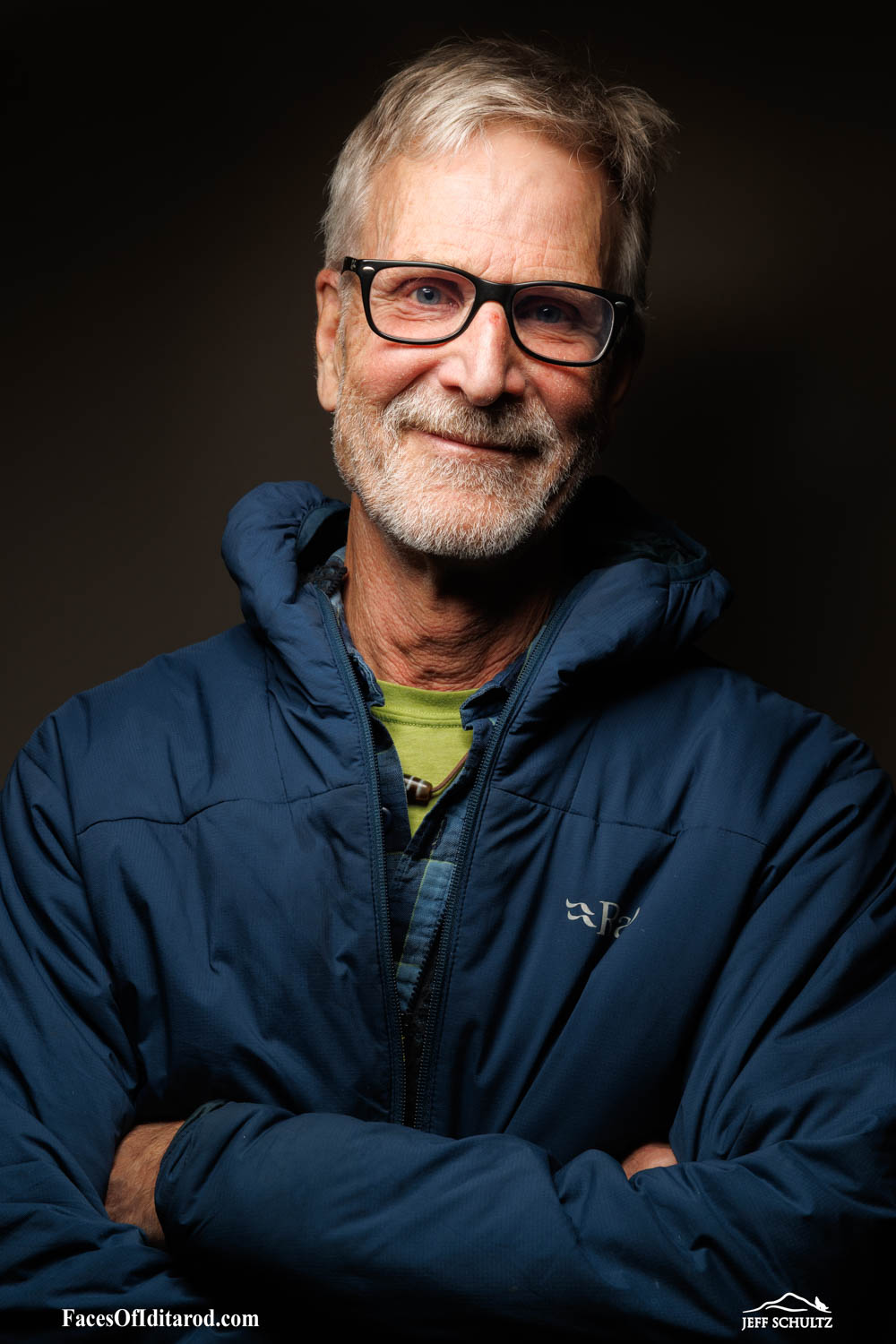
HUMAN
Name: Mark Selland
Age: 68
Residence: Anchorage, Alaska
Occupation: Retired General Cardiologist
First Year Ran Iditarod: 2015
Iditarod Role: Musher, Handler
Current Location: Anchorage, Alaska
Date of Photo: March 6, 2026
Temperature: 68F, indoors
Question 1: What is it about running sled dogs that you love so much?
So what I love about running sled dogs was working with the dogs. And what I found … I didn’t grow up with dogs. I wasn’t around dogs my whole life. It wasn’t until I started dog mushing. And what I found is all these dogs have unique personalities and characteristics and different physical traits.
And I liked the challenge of trying to get 16 dogs to function as a unit, finding the right position for the dogs and the dog team, trying to figure out which dogs are going to lead. There were small dogs that didn’t seem strong and powerful that turned out to be really amazing dogs, and there were bigger dogs that turned out to be slower and not so good. And so I loved kind of working with them and trying to get the most out of them and make a cohesive team.
Question 2: What, who or how and when & why did you first get involved running the Iditarod?
I got involved running the Iditarod out of an interest in dogs that came from living here in Alaska and following the Iditarod for many years. And then my wife and I did a commercial dog mushing trip up in Denali National Park, and it was awesome. I loved it. Loved being on the runners, loved being out there. And then because of my job, I was really busy. I didn’t have a lot of time for recreational stuff. I wasn’t able to run dogs until after about 15 years, I went into a part-time mode at work, and contacted Robert Buntzen, who was a colleague from work, and a guy that my wife had been helping handle dogs for, and asked him if he needed any help with his dog team. And Robert said, sure. And he took me on. There was no major time commitment. He let me do as much or as little as I wanted to.
But over the next year or two, I liked it. I really enjoyed spending time at his kennel and helping him and getting out with the dogs. And the next year there was the dry land training in the fall with four wheelers and then getting out on sleds. And then the race season, going to the Copper Basin, and doing the Northern Lights 300 and Sheep Mountain 200. And I really, really got interested in it. And eventually, through handling with him, I acquired my qualifiers for Iditarod. And then in 2015, I signed up. He let me take his team. And through his generosity, sharing his kennel and equipment gave me the opportunity to run the Iditarod in 2015.
Question 3: Tell me about just one of your most memorable Iditarod experiences running the Iditarod.
My most memorable experience running Iditarod was in 2015. And there is one experience that really stands out in my mind, but there are several kind of lead ups to it. The first is the week before Iditarod, and all the chaos and craziness that goes with vet checks and musher meeting, and the banquet, and getting to the ceremonial start, and going through that. And then finally starting the race. And I can remember standing on the runners, kind of pinching myself, “Yep, this is really happening.” And once you pull the hook, all that chaos goes away. It just got calm, and all I could feel was the runners, and the dogs, hearing them breathing. And I just felt totally relaxed running down … this was a Fairbanks restart year, so running down the Chena River towards Nenana. It was an amazing feeling.
Second thing was out on the Yukon River after Tanana, there was an amazing display of northern lights in the middle of the night, and I was a couple days into it, so I was pretty sleep-deprived, and it was almost like a major hallucination. And it was a really special night.
The third thing was, the big thing was I had a really horrible accident. In all my training, I’d never had a significant crash or been injured, but I hit some glaciation on a corner before I got to Manley Hot Springs. And it was one of those situations where the team was accelerating around this corner, the sled was starting to whip, and I was certain I was going to end up in the trees. And I got too hard on the inside runner, flipped the sled over, landed on my chest. I heard a bunch of noise, and got drugged behind the sled, and ended up with a pretty significant chest injury with multiple rib fractures. I didn’t know that at the time. I knew I had a broken rib or two, but I didn’t know how bad it was.
But that then affected pretty much everything going forward in the Iditarod in terms of how quick I could move, and just doing chores. But taking it just one checkpoint at a time, we got through it. I was super careful about to make sure I was taking care of good care of my dogs. I had the vets check them over and over. And eventually, we got there. And the last thing I really remember before getting to Nome was out on the sea ice as the sun was setting, seeing the road up there, where we were just going to go up on the road, finally realizing that I was going to make it. It was at that point where I thought, “This is it. We’re going to make it to Nome,” and it was an awesome feeling.
What in life do you know for sure?:
What I know for sure in life is that I would not have been able to do the Iditarod without help and support from my family and my friends, and from Robert Bunson, and from the whole Iditarod team, including the veterinarians and the volunteers and all the people who put the race on. And I think knowing the support and help from other people really applies to pretty much everything in my life, my education, my career as a physician, my experiences climbing mountains, travel in the Iditarod, that all of these experiences were made possible with the help of other people and mentors and people willing to give you a break and give you a chance, so I’m grateful for that.