

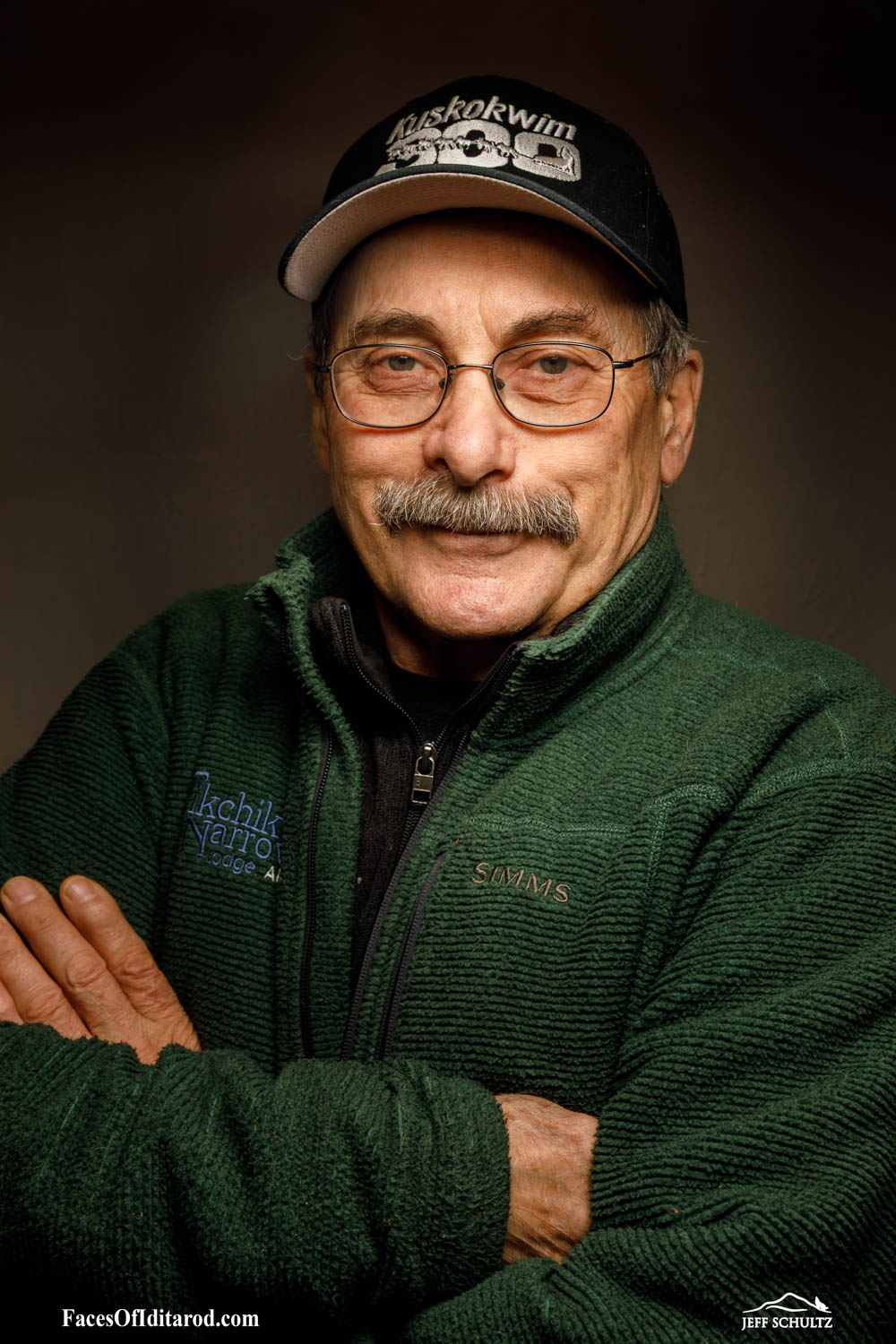
HUMAN
Name: Myron Angstman
Age: 78
Residence: Anchorage, Alaska
Occupation: Lawyer and Race Chairman for the Kuskokwim 300
First Year Ran Iditarod: 1979
Years involved with Iditarod: From the beginning
Iditarod Role: Musher, Race Judge
Current Location: Anchorage, Alaska
Date of Photo: December 27, 2025
Temperature: 68F inside
What is/was your first and continuing motivation to run sled dogs?
My first motivation to run sled dogs was way back at the start of the Iditarod, when I read the Sports Illustrated article about Fat Albert, I believe the dog’s name was. I was in Minnesota in law school, and I thought, well, I’ve always had a very strong interest in dogs, I grew up with farm dogs, and a great interest in the outdoors as well, and I thought this is a pretty good combination. So, I read that article and I moved to Bethel after law school, took a job as a public defender, and there was a pretty active dog racing community out there and I got involved in that way. And then I was focused on the Iditarod, and took part in the Iditarod as my first race actually. But I continued to run dogs because coming home from the Iditarod in ’79, I decided to try to form a dog race in Bethel called the Kuskokwim 300, and I have been chairman of that board ever since, from ’79 until today.
And I ran dogs in that race and have been actively involved obviously as chairman that whole time. And I continue to run dogs because for me it’s a release or escape from daily routine, and I really enjoy training dogs, probably more than racing. Being out in the country for a few hours at a time with dogs has always been a thrill for me.
Question 2: What, who or how and when & why did you first get involved running the Iditarod?
I first got involved in running the Iditarod because I had just started with dogs in the late ’70s out in Bethel and the Iditarod was one of a few distance races around then. There were a couple, but there weren’t many. And it was really all you could focus on if you wanted to get involved in long distance dog racing. So, it was available, and I had an opportunity to borrow, which I did, I borrowed a bunch of dogs from people, Rudy Demoski and a few others, and I got involved because it sounded like a gigantic adventure, and it truly was.
Tell me about just one of your most memorable experiences running the Iditarod:
My most memorable experience running the Iditarod was falling in with a veteran racer in my first year, by the name of Bud Smyth, a very colorful character in everybody’s estimation. And he was back in the pack, I was in the middle of the pack, and he would normally be ahead of me, but he was actually having trouble that year. He was down to five dogs very early, and we ended up spending a lot of time together. And one night around a campfire, because we used to have campfires in the Iditarod, he tried to convince me to take on a second wife. And I thought that… He’s a Mormon fellow, and he thought that was probably a good idea for me to have another wife in addition to the one I already had. And I said, “I didn’t think it would go over that well with my wife,” and he says, “Oh, it’s just a matter of training.” And that was probably the most memorable experience I had on that particular event.
One other event that sticks in my mind regarding Bud, he had a half wolf dog in his team. And he was having trouble with this dog, and it was an aggressive dog. And he was having trouble with it, and one time I passed him in deep snow and we had to ease our way past, and as I came by, I could see he was right next to that wolf dog, and when I got right next to him, I noticed the wolf dog had his arm safely tucked in his mouth. And I said, “Hey, Bud, anything I can do to help?” He says, “Just keep going, quickly.” And I left and saw him later that same day and he had a wounded arm, and I guess it took about 20 minutes to get that wolf off his arm. So, that was a memorable experience.
What in life do you know for sure?:
Well, what I know for sure about life is that it sort of demands that you stay active. And I learned that from an old Indian guy who was my helper for 30 years. His name was James Nicholas. He was from Grayling. And he was quite a bit older than I was. And every once in a while he’d get a little injury or get a little ill. And I would tell him, “James, you should go home and take a rest.” And he says, “Oh no, I can’t do that. ” I’ve known a lot of old guys that went home and went to bed when they got sick, never got up again. You got to keep moving.”, he says. And well, you know, he’s kind of right. And I’ve taken him to heart and I keep moving, and I intend to do so till I can’t move anymore.