

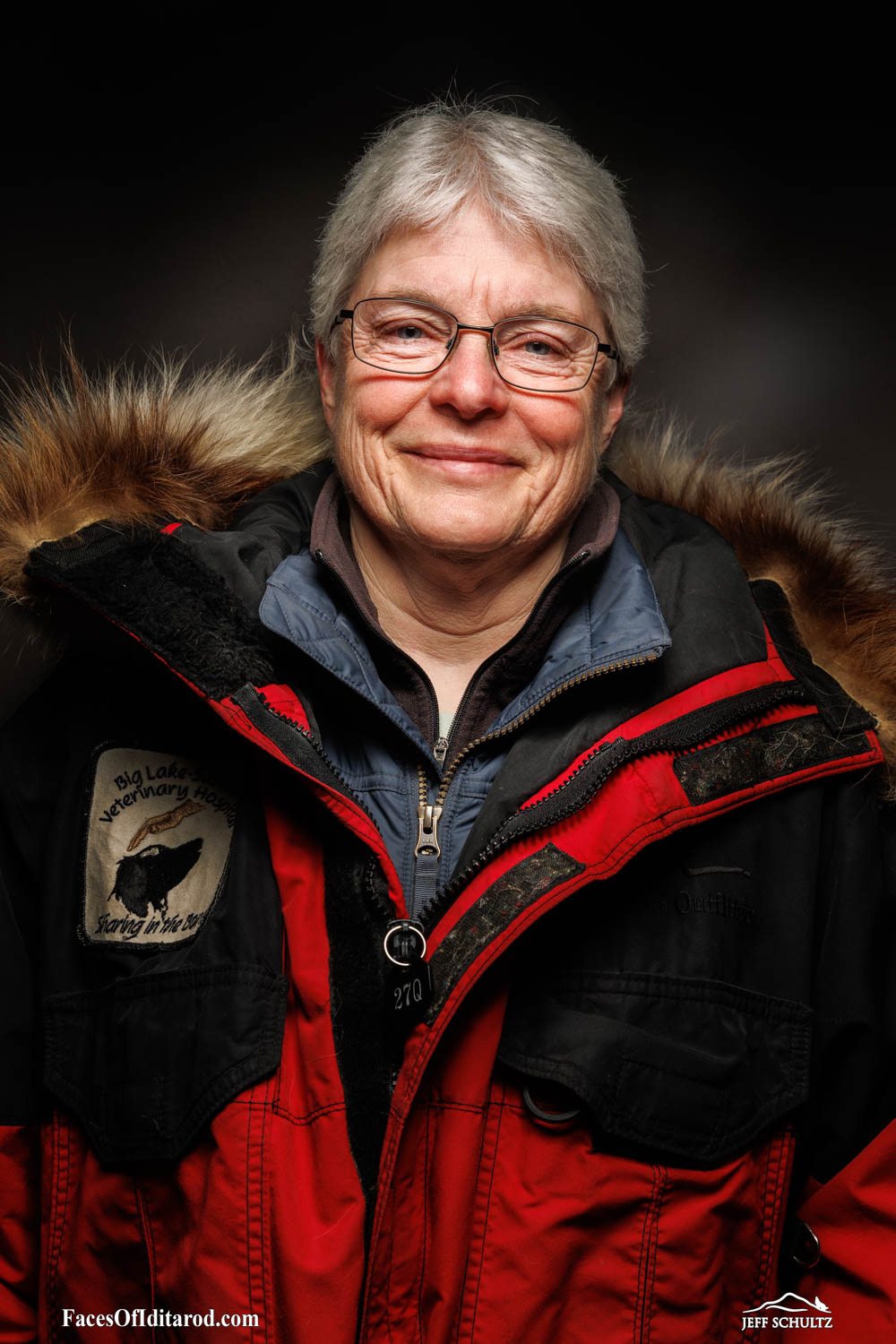
HUMAN
Name: Sue Allen
Age: 66
Residence: Houston, Alaska
Occupation: Retired Physical Education Teacher
First Year Ran Iditarod: 2004
Years involved with Iditarod: 24 years
Iditarod Role: Musher, Handler, Helper
Current Location: Iditarod Headquarters Vet Check, Wasilla, Alaska
Date of Photo: March 4, 2026
Temperature: -1F
What is it about running sled dogs that you love so much?
What I love about running sled dogs most is just the dogs themselves. They’re amazing athletes. They’re great companions. They are adaptable. They teach us so much. They teach me so much. They just love what they do. They love sleeping in straw at 20 below, they love sleeping in front of the wood stove at 60 above. They’re just so adaptable.
And on the runners, it’s just mainly taking me places that I would never dare go on a snow machine by myself. And it’s just so awesome that I can take dogs on a sled, really go wherever we choose to go through any challenges. They’re so eager to please and eager to run and eager to take us through whatever we need them to take us through. And they come out the other side no matter what, smiling and happy and ready to go some more. And I just like that they teach me about living in the moment, allow me to be out enjoying God’s creation, and just teaching me how to enjoy life every moment.
Question 2: What, who or how and when & why did you first get involved running the Iditarod?
I got involved running Iditarod because my husband’s nephew had come up from Kentucky and we took him here to Iditarod headquarters, and Lynda Pletner gave him a dog sled ride. And seems like that fall, I got to thinking that kind of looks like fun. So I called Lynda and I said, “Do you think you could give me a couple old dogs that might teach me something?” She gave me two little old leader girls. I came home, borrowed another friend’s dogs and hooked them up to a sled and was just impressed that these little 45-pound females could just pull me down the trail.
So I started getting a couple more dogs and ran sprint races and then started to help Lynda at her kennel in exchange for dogs and in exchange for training. So I trained with her for a few years. And then one year, I think it was ’99, she invited me to Nome to handle for her. And so I flew up to Nome and missed all the winners coming in, but the middle and the back of the pack, I watched come down Front Street and I saw look in musher’s eyes that I had never seen before. I expected either total elation or just total relief that it was all over, and I didn’t see any of that. I saw just a look in people’s eyes that was such a mix of so many emotions. And right then I thought, “I want to know what that feels like.”
And of course I had Lynda as a mentor. So I got enough dogs, ran my first qualifying race. And on that qualifying race, it was an alley 300. She had given me a dog named Atlas, who was a nephew, I believe, of her famous dog, Argie, who was the most competitive dog I’d ever seen. He would just pick off teams. We’d just be going down the trail. And at our normal pace, and then he would come up behind a team and he would just start trotting their pace. And then I hollered, “On by.” He just sling-shotted past that team, pick off the next team. I never knew dogs were so competitive. And so I thought, “If I’m going to do Iditarod, I better do it while Atlas is young enough to take me there.” So that’s how I got into Iditarod.
Tell me about just one of your most memorable experiences running the Iditarod:
My most memorable experience running Iditarod is a story that Terrie Hanke could probably tell better than I could tell because I told her this story and she has since told it over the years to the teachers on the trail and to the kids. I made a lot of mistakes running my first Iditarod, like we all do. And being a full-time teacher, I didn’t have a lot of time to train leaders. I didn’t have a lot of time to take young teams and work off trail training. And so I left the start line with three good established leaders and then a bunch of young dogs.
And what happened was I ended up sending Atlas home in Yentna. I sent Bossy home in Finger Lake for different reasons, which left me with one good leader. And I thought, “Well, that’s okay.” So I left Finger Lake with Uban in lead. I put one of the younger boys up there with her. And I didn’t know this till I saw pictures year later of me leaving Finger Lake, the cue was right there for me that I didn’t pick up on, on the mistake I was making of putting the young dog up with her.
So anyway, things were going really well. I was going between Cripple and Ruby. I stopped for a break because that’s a long stretch and the dogs had this diarrhea and they just weren’t feeling good. And so I left them for a while and then they were just sleeping, but then they’d wake up and got seen a little antsy. So I thought, “Well, let’s just move down the trail.” So I started moving them down the trail and Uban didn’t want to go. And of course, all other 13 of those dogs were screaming to go, but Uban wouldn’t leave.
So I ended up just trying every dog in the team up front. Couldn’t go anywhere. If I’d go up front, they would, but then they’d run me over. So I ended up getting in my sled bag with Uban to sleep. It was the middle of the night. And finally after six or eight hours, they seemed that their diarrhea was getting a little better. So I got up, bootied everybody up. I put the one dog I thought would be the best chance to try this time, even though I had tried her before. Sydney, I put her up front with Uban, extended the leader section enough that they could be away from the Yaehoo’s in the back, and that was the ticket.
So we went down the trail and about 20 miles outside of Ruby, Billy Honea came out on a snow machine. He goes, “Yeah, they sent me out to look for you.” I said, “I’m fine. I’m coming. I know I’ve been out here a while.” This was long before the days of GPS trackers. And so anyway, he took off to go back. And after he gave me so many words of encouragement, because I was so discouraged, I thought, “I’m not even sure I’m going to make it to Ruby. Are they going to keep going this well?” But he was such a godsend to me on the trail at that time, it was like an angel, just with the words he had and the wisdom he had.
So then I get into Ruby and Bill Borden was there, who had run Iditarod a couple years before with some of those same dogs, Sydney being one. And I’m a mess. I’m crying, thinking my race may be over, I really screwed up. I had to find a new job because I’m a teacher and a coach and I’m always the one preaching. There’s no excuses. Finish the job. And Bill just laughed at me and he said, “Go take a nap.” And so he said, “Your perception and reality are two totally different things,” which is exactly what I needed to hear.
Went and took a nap. We left them there for a while. They got on antibiotics. They were feeling better. Hooked up Sydney and Uban up front away from the Yaehoo’s and we took off down the Yukon River and everything was great. And I thought, “Oh, thank you Lord. We’re going to make it.” And about 10 miles out of Ruby, Sydney starts a little limp, and I thought, “No.” So I went and got her, put her in the basket and then turned and looked at the team. I thought, “Now what do I try?”
Well, there was only one dog I had not tried, and that was Gopher. He was an older dog. He had run a few Iditarod’s before, never led. Would never lead for me, ever. Just a little steady team dog. So probably the last one to make my team, and he made my team because I wanted a 16 dog, so I put Gopher in there. Anyway, I put Gopher up front with Uban. He’s the only dog I hadn’t tried. And I sat him there and he was sitting down, and I walked back to my sled thinking, “Is he going to just follow me back to the sled and turn the team around?” I got back to my sled and I looked and there he was just still sitting there looking at me. And I said, “Ready?” And he stood up and he looked down the trail and I said, “All right.”
We ran the next 400 and some miles flawlessly to Nome. It was the most fun I ever had on a dog sled. And to this day, I have no idea… How did I ever overlook the potential of that dog? He never led for me again after that, but he knew we needed him. And we had so much fun because they were so well rested. I finally had a system that worked and pairs that worked and they were enjoying themselves. Checkers were kicking us out of checkpoints because they didn’t need the rest. I did. And they were playing with each other and waking up other teams. And I never stepped off the sled. I never stepped off the sled going up Little McKinley. I never stepped off the sled going over Cape Nome. They were just on fire. And it was, to this day, the most joy I ever had driving a dog team because of that little dog named Gopher. And if it wasn’t for him, I would have flown out of Ruby.
What in life do you know for sure?:
What I know for sure in life is this life and this world is not all there is. There is a heaven, there is a Lord, there is a God. I’m not him, and he is totally in control, and my life belongs to Jesus. And for that, because of that, I know where my eternity is.