

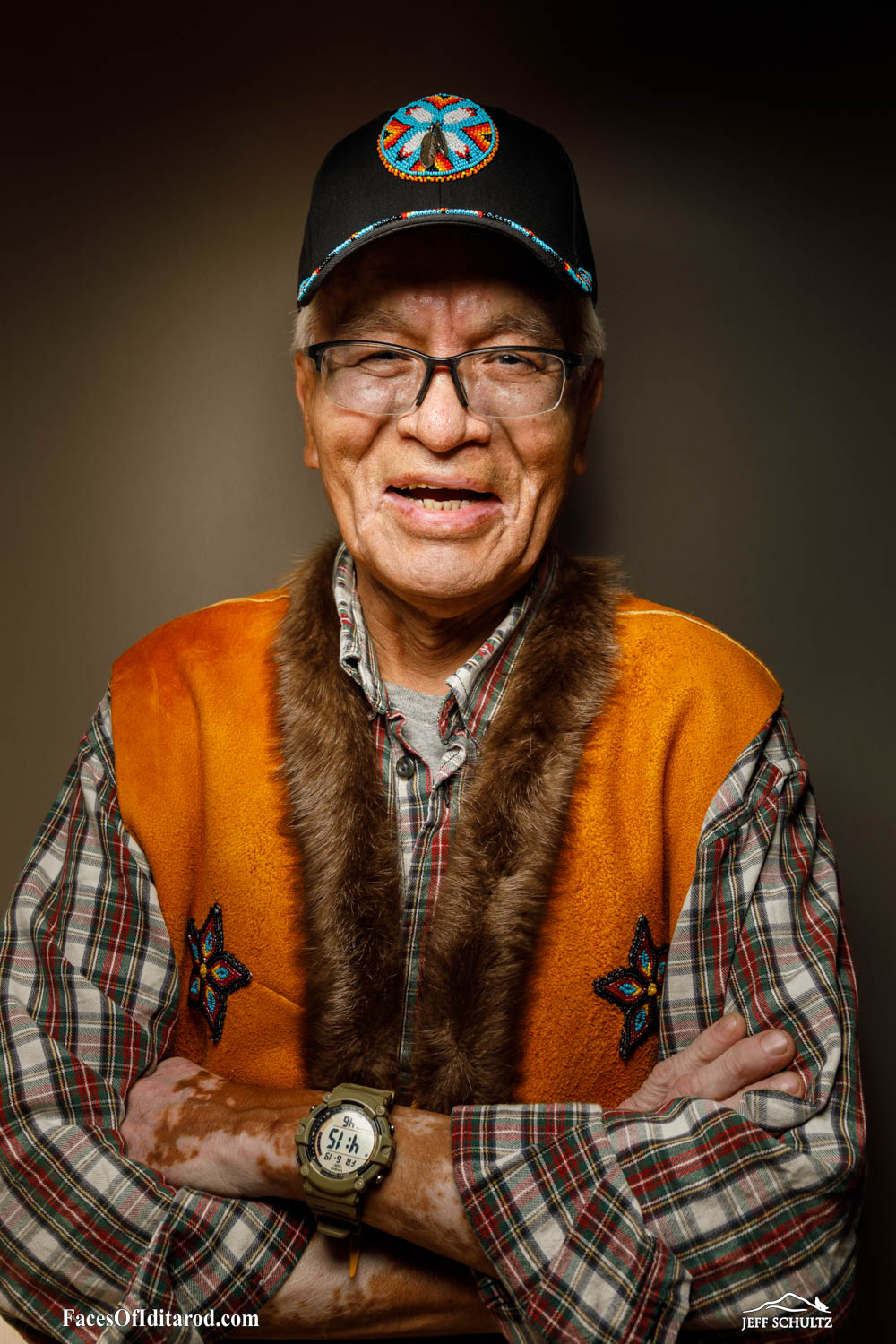
HUMAN
Name: Gary Attla
Age: 69
Residence: Fairbanks, Alaska
Occupation: Retired from drill rig and loader operator
First Year Ran Iditarod: 1981
How Many Years Involved With Iditarod: 10 or so years on and off
Iditarod Role: Musher
Current Location: Fairbanks, Alaska
Date of Photo: June 19, 2026
Temperature: 78F outdoors
Question 1: What is it about running sled dogs that you love so much?
What I love about sled dogs is all the dogs working together as a team after putting all your effort into Iditarod because dog mushing is not a six-month sport. It’s a 365 day, year round event. You have to be there for those dogs every day. And when everything comes together, that’s when you really appreciate how much work you did and everything is so wonderful when you can see those dogs stretched out and they’re just going to keep on going. I mean, they don’t want to stop.
Question 2: What, who or how and when & why did you first get involved running the Iditarod?
I got involved running the Iditarod because my dad was… That’s a big question, ’cause my dad had a lot of dogs. And ever since I was about 16 or 14, 15, I started helping him handle dogs, and by the time I was 16 I was his main gopher. Yeah, I got stories that I could tell you about his dog mushing skill.
And I just picked it up. I picked it up and I knew… By the time I got in the Iditarod there was dog mushers teasing me that they weren’t going to have the Rookie of the Year prize, because they didn’t consider me a rookie.
But I got involved because of the camaraderie, traveling together the other mushers, and the competition. And I could tell you right there, the competition is stiff. As mushers, they’re competitive in everything they do. It ain’t only dog mushing, it’s just… every little aspect of life they got to be on top. If they don’t cover all the races, they ain’t going to be in the top ten. They have to know what they’re doing on…
And taking care of your dogs, that has a lot to do with it. Because if you can’t take care of your dogs… All you have to do is look at another person’s dogs and you know, they’re either sick or something that’s not right with them. But if you’re a dog musher and you’re around them long enough, you could look at another dog team and you know what kind of shape they’re in. And most of the time I look at those dog mushers and I say, “Holy cow, look at that team. This is awesome, man. Holy cow, look at that. You can’t stop them.” Yep.
Question 3: Tell me about just one of your most memorable Iditarod experiences running the Iditarod.
My most memorable experience on the Iditarod was between… This year we went between Anvik and Unalakleet. We didn’t go up the Yukon or by Ruby, we went straight down to Grayling to Anvik to Unalakleet. And there’s lots of mountains going that way. After you get, I’d say, a hundred miles out of Anvik you start running into mountainous country, before you get out onto the coast. And my most memorable experience was climbing the mountain, and it was a real steep mountain. And I looked up in front of me and the late Joe Redington Sr. was looking down at me from up above with his camera, taking pictures of me and Martin Buser. Martin Buser was behind me. Yeah, that’s my most memorable experience.
But there was a lot of things happened on the Iditarod that I really… I really had a lot of fun. I mean, it’s still fresh in my mind even though it happened 40 some years ago. Yeah. But Joe Redington Sr., he was sitting in the back of his sled looking downhill at us, taking pictures with his camera, that’s how tough he was. Yeah.
What in life do you know for sure?:
What I know for sure in life is, appreciate it. You have to appreciate what you have. And a lot of people don’t realize that, but I stayed in a 12-foot wide by a 29-foot cabin for 20 years. And it took me 15 years to appreciate it. So stuff like that, I mean, you have to appreciate the small stuff. But the first time my dad went in there, it was small and he said he went to sleep in there sitting on an the easy chair. And he said he really relaxed in there, and he relaxed right away.
But you don’t know what you have till you don’t have it. Yeah. Yeah, you don’t know what you have till you don’t have it, and it’s just right there and you have to appreciate it all. And I know I have it made. I got grandkids, I got great-grandkids. And I still get to visit these other mushers too, and tease them. But a lot of them are passing on now. Yeah, a lot of them are passing on.
And I had lots of fun with… I broke arms with Susan Butcher when we got to Nome. I told Jeff King that, too, because he was there, he was there when we did that, at the board of trade. They had those big round cable spools for tables. And I was telling her about how I broke everybody’s arms out of the river. I was pretty strong, I was a gopher for how many years. I was strong. So right there I told her I could break arms, and she said, “Well, let’s break arms.” And I said, “Okay.”
And so we started getting everything ready, and all of a sudden everybody in that old bar knew we were going to break arms. And we got out to this table, those thick tables. There’s no way you could break those tables. And I thought… I know a lot of tricks on how to beat people in breaking arms, you could suck them in, twist their arms. And so I thought, “Well, I’ll just go straight up with her.” So I went straight up with her thinking, “This is going to be no problem.” And then we started breaking arms and I got her right there and she stopped my arm, and I couldn’t move my arm. Then I started thinking, “Man, I’m in trouble here.”
And I started trying, I really started putting my strength into it. And my first cousin, Ron Attla was my handler, and he was there. He was in that bar at the same time. All the dog mushers and handlers were in that bar. So everybody, even Jeff King was there. I put it on Facebook and Jeff King said, “I remember that, I was there.” So he could verify. And then I was breaking arms with Susan Butcher and I had her right there, and I couldn’t do nothing. I looked over and there’s my first cousin Ron, yapping and a big shit-eating grin on his face. And I thought right there, I thought, “If I don’t beat her and she beats me, I’m never going to hear the end of it.”
So I started putting it on, putting it out, and I started putting her arm down. Then she locked up again right about there and I couldn’t put her down. And I was trying my best. Finally she gave up and I beat her, and we were both just totally drained after the Iditarod and all that. And so I said, “Well, you want to try the..” I didn’t have no strength left to try the other arm. But I said, “Do you want to try the other arm?” She said, “No.” Yeah.
So we had fun, yeah. We really had fun. But that’s the competitiveness in the dog mushing world. Every dog musher I know is like that. They figure out how to beat you with their mind if they can’t beat you with the dogs. And that’s one of the things I learned from my dad.