

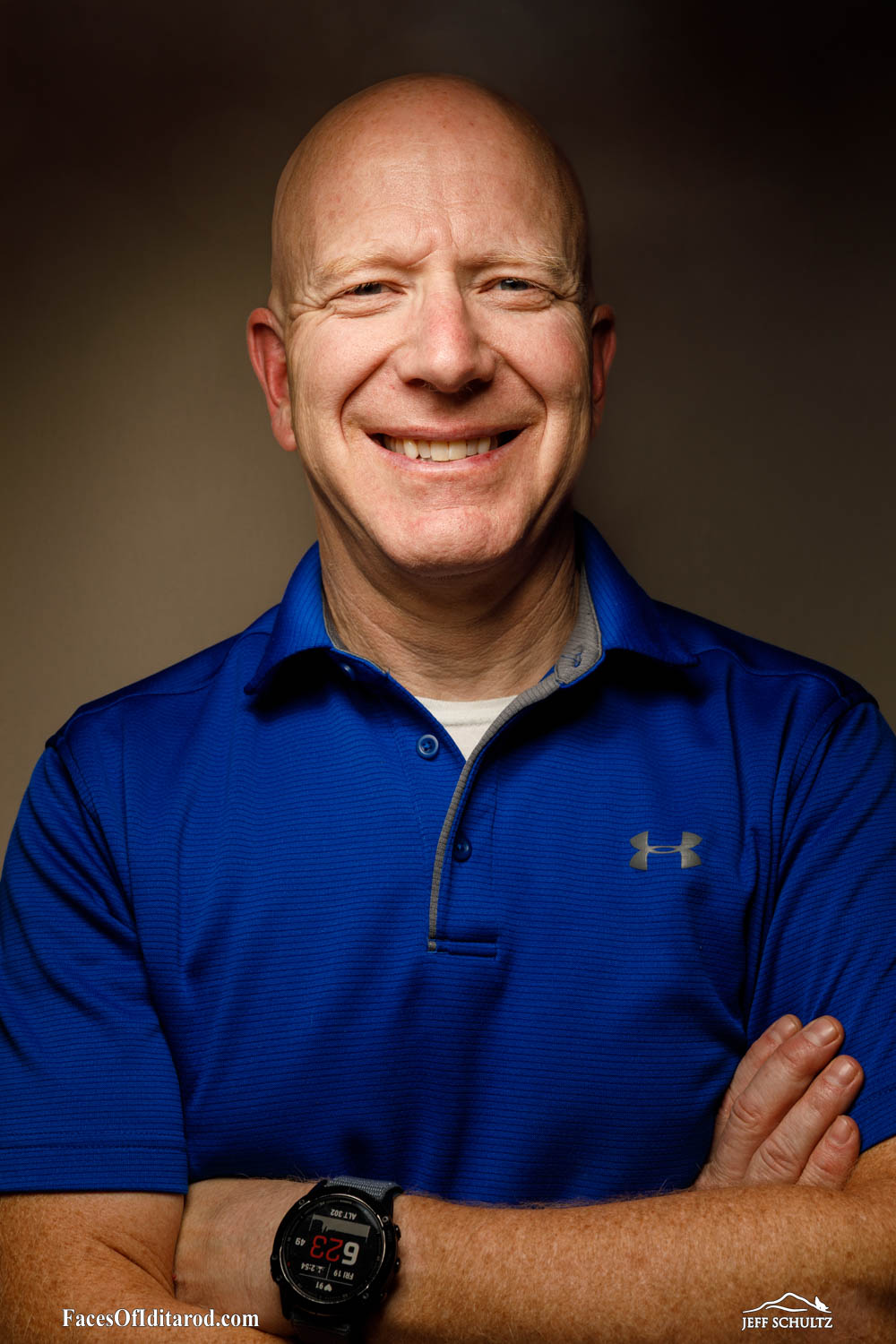
HUMAN
Name: Christopher Knott
Age: 53
Residence: Two Rivers, Alaska
Occupation: Financial Planner for Edward Jones
First Year Ran Iditarod: 1998
How Many Years Involved With Iditarod: 10
Iditarod Role: Musher, handler, dog training
Current Location: Fairbanks, Alaska
Date of Photo: June 19, 2026
Temperature: 78F outdoors
Question 1: What is it about running sled dogs that you love so much?
What I love about running sled dogs is, by far, the relationship with the dogs, the feeling of being on the runners, the power behind the team, gliding across the snow, the northern light streaking over your head, pitch black, full moon, cold temperatures. They’re just such wonderful animals. You can feel it as you train them and work with them and certainly racing. They put their lives in your hands and you put your life in theirs. And it’s an unbelievable bond. It’s something that, every time I’m on the runners, I feel from puppies all the way up to older dogs.
Question 2: What, who or how and when & why did you first get involved running the Iditarod?
I got involved running the Iditarod. I went to Clemson University. Was playing a lot of basketball. And when I got there, probably like most freshmen, I didn’t know how to study or do anything academically, and I was just more interested in playing basketball, going to practice, going to games. And that first year, my grade showed. So I got a one seven and all the basketball people told me I needed to start focusing on my grades, get my grades up because if that continued, I wasn’t going to be on the team. And so still played basketball my second semester of my freshman year and buckled down and started studying as much and as well as I could. And so by the end of the semester, I earned a one six. And so kind of going in the wrong direction. And I went into the offices and they said that I wasn’t going to be on the team the following year.
And so I decided that I really needed to start studying. And so I buckled down sophomore year and studied and studied and started getting hang of it, started playing basketball again junior and senior year and I wound up graduating with honors, but I was sick of it. I needed a break from studying. So I had been accepted at North Carolina and Wake Forest for grad school and I had just finished reading a book about crossing Antarctica by dog team, by Will Steger. And so I looked in the back of that book and a gentleman named Dan MacEachen had lone dogs from his Krabloonik kennel in Snowmass. And so I called him up and I said, “It’s perfect. I’m from Colorado. Do you need any help at your touring kennel in Snowmass?” He said, “Nope, I don’t.” But he said, “I do need help at my racing kennel up in Alaska.” And I was like, “Perfect. That’ll definitely give me a break.”
And so came up to Alaska not knowing anybody. Dan picked me up at the airport and I helped run dogs at his kennel for the year. And he had a huge kennel, probably 175, 200 dogs. And halfway through the year, he had to spend all his time down in Snowmass because his chef quit. And so I was left to take care and run 175, 200 dogs, and it was hard work, but unbelievable.
And so then the next year, I worked for Kathy Swenson for two or three years and then helped out with Rick a little bit and just started acquiring my own dogs. And as I was acquiring dogs, I just started thinking more and more about starting to run Iditarod. I had met a vet in South Carolina. I was doing a report on reintroducing wolves to Yellowstone and I needed to talk to a vet. So I just happened to call him up and he was an Iditarod vet. And so we talked about the wolves being reintroduced and started talking more and more about Iditarod. And I could just feel it inside of me, just the passion and energy and just that interest start to come out. And so once I got up here and started getting enough dogs and started doing the qualifying races. I’d done all the mid-distance races, but started doing all the enough miles to qualify and just started getting into dogs more and more, and it just exploded from there.
Question 3: Tell me about just one of your most memorable Iditarod experiences running the Iditarod.
My most memorable experiences running the Iditarod are, my dad had just passed away here recently. And when I was doing my first Iditarod, my parents came up to help and Fourth Avenue and the whole chaos. And I remember my mom trying to put harnesses on dogs and dogs are going crazy and she’s just having a hard time. My dad rode the runners to the starting line. And so that was a lot of fun. I remember thinking… Growing up, you always hear, “You’re underneath my roof.” But when I was on the runners getting pulled by the team that I’d trained, I remember thinking to myself, “You’re under my roof now.” And so that anymore is a super special memory for me.
Down the trail, I also remember… I think about this one a lot. We were just leaving McGrath and it was probably 47, 48 below. It was probably eight or nine o’clock. So I knew it was going to wind up getting colder. And so when we left, I was dreading it. Being cold on the runners, I knew I was going to be pushing and running a lot just to stay warm. And we probably got an hour or two out of the checkpoint. And all of a sudden, the team sped up and started going faster and that’s always a sign that there’s something on the trail. You hope it’s just a rabbit or something, but the fear is always the moose. And sure enough— moose runs across the trail. And so I clip on my headlight and see the moose go across. And probably 20 seconds later, about four wolves go across the trail and they’re in hot pursuit. And probably five minutes later, the same thing happens, going left to right this time. And so the moose comes across the trail.
And 10, 15 seconds later, the four wolves go across. And it happened so many times that the dogs just quit speeding up and they were watching all this action. And probably the moose and the wolves went across five, six times back and forth on the trail and they’re just back and forth and back and forth. I don’t know what happened, but we were in the middle of this chase scene. And I had the headlight on just keeping an eye on the whole thing because I didn’t know if the wolves would turn and attack their brethren or what. I had been involved in moose attacks and things like that before. So I knew what to expect there, but not a pack of wolves chasing a moose.
So that was interesting. That was great. It was a full moon out. So you could see everything. And with the headlight on, it lit up the whole thing to where the chase just felt like you were in the middle of some Hollywood chase scene, cars going everywhere. So that was a lot of fun.
And then another one I think about a lot is, at Unalakleet, there’d been stories, rumors of a bad ground storm coming through at prior checkpoints. So came into Unalakleet, bed dogs down and fed them and went inside. And we were told by the checker that in about 10, 15 minutes, there was going to be a mandatory mushers meeting, that everybody had to be there. And so I got there a little late because I had just come into the checkpoint. And walked in the back doors and just stood there and the meeting had already started and they started talking about this bad ground storm, that they were in touch with Iditarod headquarters about possibly closing the checkpoint. So as I said, I was towards the back of the room and I made sure that people had seen me because I came a little bit late. So I made sure that everybody knew that I was there.
And I’d been through ground storms. I’d done the 440 before. And coming back into Kotzebue, I’d been in a bad ground storm chasing Johnny Baker. And so I felt comfortable being in a ground storm. And so I slowly walked backwards and opened the back door to the community center and got out of there and went over to the dogs and started hooking them all up and taking off jackets and everything. And dogs were looking at me like, “Why are we leaving already?” And they were wondering where their treat was before we started hitting the trail. And so I said, “You’ll get your treat.” And so we got out of the checkpoint and fed them and just stayed around the corner a little bit.
And when it was eventually time to go, got them bootied. And as you leave Unalakleet, you got to go around the airport. And as we went around the airport, it was a warm year and there was probably two feet of water. And dogs were swimming and it was up to their chest and trying to run through the water. And trail markers were floating on top of the water. And I remember thinking, “This was a bad idea.” I didn’t even know where I was going, trying to find trail markers that are floating on water. And so eventually, we get to dry land, peel all the booties off that you spend so long putting on and put on new ones.
And finally, we take off, going up the Blueberry hills. And so climbing, climbing, climbing. And the farther up we go, it just sounds like a freight train at the top. It’s loud. The closer we got, it just got more and more so. And I remember thinking… Having done it before, I thought, “Why is this… There shouldn’t be anything making that type of noise up there.” So it started slowly occurring to me that that was the wind. And so as we got closer and closer, I realized I need to put on dog jackets if the wind is that bad.
And so I stop. Everybody had their jacket on and we crested the top and just got blasted by the wind, just blasted to the point of… It’s a three or four mile downhill and I had to run behind the sled, pushing the sled downhill. It’s a thousand-foot climb or so. And so just pushing the sled, trying to get through the wind. And so it was coming all the way down the hill and then you got to that blow hole down there at the bottom going to Shaktoolik. And couldn’t see anything, couldn’t see the front of the sled, couldn’t see the wheel dogs, definitely couldn’t see the leaders.
And so I’m crouched on the runners and I keep a knife on the stanchion of the sled for emergency. So I take that out and I’m crouched on the runners, sitting on my boots and just putting the knife into the ice, just trying to pull, just trying to help the dogs any way I can. So I have no idea where we are. You start doing a mental geography and you start realizing, “If we start heading off to the left, we’re in open water, Russia.” I started thinking about Russia. And so I started getting a little bit more concerned as we went and just clawing along, clawing along, probably two or three hours, and all of a sudden, the dogs just come to a stop. Just a stop. And I’m thinking to myself, “Oh, great. We’ve hit Russia. I don’t have my passport with me. Open water. If they go any farther, we’re going to be on the bottom of the Arctic Ocean.” And so they stop, just stop, and everybody does, the whole team. It’s not the wheel dogs pulling and the front end stopping or anything like… Whole team stops.
So I get off the sled and hold onto the gang line, walking up the sled so I don’t get separated from the team. And I get up to Charlie and Hotfoot, “What’s going on? What are you guys doing?” And they’re shaking and chewing booties off and they’re pretty sure that we’re camping right there. And I’m thinking, “Oh, God, this is bad.” And so I’m like, “Charlie.” And he just looks up at me. I’ll never forget the look… If a dog could give you a look that says, “You have no idea what you’re doing out here, buddy,” that was the look that he gave me.
And so I started looking around and I see a light 10, 15 feet away. I started looking around more and more and started seeing these just very dim lights because you couldn’t see anything because the blowing snow, wind. It was night. And so you just couldn’t see anything. Started seeing these very dim lights. And I realized that the dogs took me across the sea ice. Outside of Unalakleet, there’s all those little fishing huts, and they took me all the way through that, all the way up to the checkpoint door, the door. They didn’t go into the dog yard. They took me right up to the Shaktoolik checkpoint door. So that’s where you start realizing that your life is in the dog’s hands. That’s when you realize how special of a bond that winds up being.
Then the other one that I probably think about is, so we were racing. Hans Gatt and I were racing for, I think, 20th place. I think there was 110 entires that year and that was when they just paid through 20. And so I had an hour lead on him or so. And left White Mountain and you’re exhausted in the race. You are so tired. And White Mountain is just… They all look you’re either going uphill or you’re coming downhill. It’s constantly rolling hills and it’s night, of course.
And so we’re cruising and I just start hallucinating, just hallucinating. At one point, I’d worked as a river guide on the Colorado River and I just started thinking that as I was mushing, I was really canoeing. And we were just sitting there canoeing with my friend, Bernie, and just canoeing down the Colorado River. And I remember having a conversation, just talking to him. Then we went for a while and I snapped out of it and then we went for a while longer and then I stopped the team. And I go up to the leaders, Charlie and Hotfoot, and I grab them and I turn the team around. I get back on the sled and start going again. So then Hans Gatt and I are going towards each other. We’re going right at each other, cutting the lead that I had. And so all of a sudden, I stop and I start thinking to myself, “Wait a minute, did I really turn the dogs around or am I hallucinating this?”
And so when you’re hallucinating, everything seems so real. It’s like you’re living the hallucination. It’s as alive as me sitting here. And so I stopped the team and I could not figure it out. I couldn’t figure it out if we were still headed in the right direction or if I really had turned the team around and I needed to turn them back around, or if I turn around again, is that putting me towards Hans? So I couldn’t figure it out and it’s dark, stars. I couldn’t figure all that out. I even tried that. And so I walked up to Charlie and just pet him. And he took a couple of steps back and I’m like, “God dang it. We need to turn around.” And then he lunged forward in his harness. I was like, “All right, Charlie. We’re going to continue.”
And so got back on the sled, took off the rest of the time. I kept looking for a headlight in front of me that we were coming at each other. Thankfully, it never came. So got to Safety, blew through Safety, and got to Nome in a couple hours ahead of Hans Gatt for 20th, I think it was, and stayed in the money $12–$13,000 or so. And so I think about that one a lot, especially when I’m tired and daydreaming, something like that. I think, “Oh, yeah, Charlie saved the day.” So that was a good one too.
Question 4: What in life do you know for sure?:
What I know, for sure, in life is that life is short. Enjoy your time here. Do the things you want to do. Do the hard things. Get out there and give it your best. Enjoy it because we’re only here for a little time. We’ve only got a few times around this earth. And it’s time to get out and enjoy it and experience everything that you possibly can.