

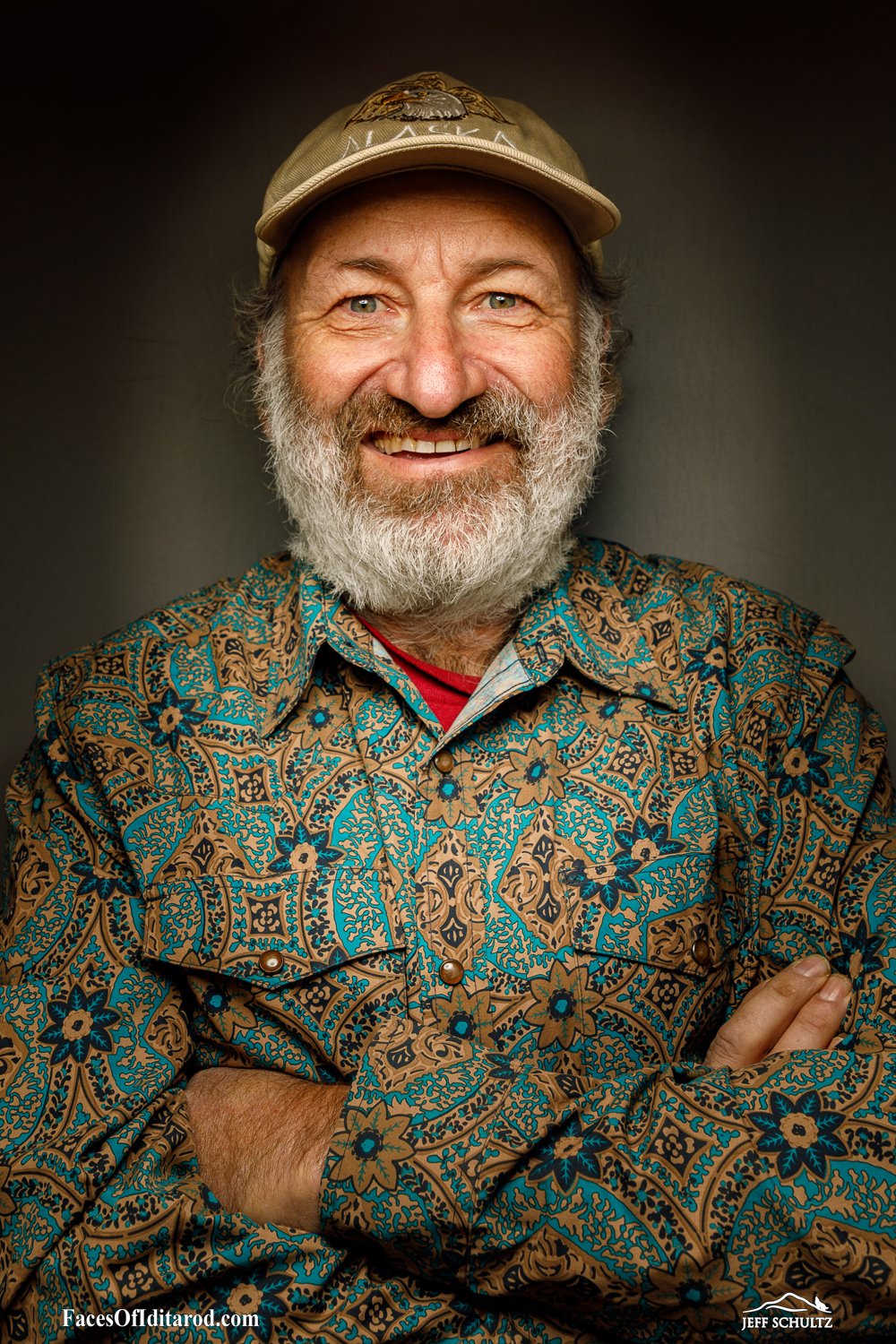
HUMAN
Name: Frank Sihler
Age: 61
Residence: Arizona
Occupation: Teacher of different things
First Year Ran Iditarod: 2004
Years involved with Iditarod: 3 years
Iditarod Role: Musher
Current Location: Rio Verde Foothills, Arizona
Date of Photo: January 26, 2026
Temperature: 55F
What is it about running sled dogs that you love so much?
What I love about to run the dogs was that in the winter months when the nature gets more quiet, there’s less people around. And I came from Europe, so in the winter months in Europe, in the Alps, there was just not so many people around. And to be with dogs, you could get around, they could move your luggage, right? So we could do winter camping with them and we could get to places where we could stay overnight where you normally had not a chance to, unless you carry a lot of weight. And back in the days we had only normally minimal skis to do it. It wasn’t comfortable. So the dogs allowed us to get into areas where we could basically feel like we would be in Alaska or in Canada somewhere. So it was really awesome.
And the animals were always super friendly. They were just giving everything. We went a couple of times on glaciers in the Swiss Alps and we went really high in a mountain and over glaciers. And the dogs, they never did anything like that before, but for them it was just to be with us and had a great time and we loved that.
Question 2: What, who or how and when & why did you first get involved running the Iditarod?
So I got involved in the Iditarod in 1990, because there was the Alpirod and the Alpirod was already on the way for a couple of years prior to that. And so, you could see the pictures and the stories. And it was a very adventurous race. It was going parts to France, Austria, Switzerland, Italy. And we got also the first idea how North American mushers from Canada, Alaska, who was already kind of famous and you could get connection to it. So we met Colonel Vaughn back then and he participated in there. We saw the Runyan’s and the Swenson’s. And so, that was just an atmosphere what I normally could not get in Europe unless I would have come over to America.
So the race was challenging. I did it twice. We finished and it was just a beautiful experience. And back then the Alpirod was also a qualifier counted for the Iditarod. So the dream was basically born there to get involved to run it one day. But then it took quite a long time from the 90s into 2003 and four where I was running twice there, finished as a rookie at 2003. I loved it. I said, “Yeah, I need to do that one more time.” And then I did it a year later and then I had a little bit of break. And then in 2007, it was the last time I was running it. And so, that was my involvement. And then I had a young man, Jeff Deeter with me, who was basically a small kid back then, and he had his team, he worked with me in my kennel. And after all these years, he is an Iditarod musher who probably a lot of people know. And so, that was fun to see that the legacy is going on.
Tell me about just one of your most memorable experiences running the Iditarod:
So, one of my memorable Iditarod experiences was basically running down. We ran that year in 2003, we ran down a lot on the river, on the Yukon River. And on the river, it was never changing temperature, it was always cold, cold, cold. And when you go in the race, you have your schedule and stuff like that, but then you get many times on mental, on the border of your capability, and when you get cold, it gets to you. That was after Ruby. No, it was before Ruby, actually, before we came into Ruby and I had to just stop my team, forget the race, start a fire. I did dig with my food bowls a hole to get kind of deep down in the snow, so actually that the fire can get started and I had to really recuperate there.
And after I had that fire and I got really warm again, so then life was different and I could continue. And then I never had that again in the whole race, right? But that was really, I was down. I said, “No, I need to stop. I need to have it warm. I need the fire.” And I did it and then it was good and I was back to normal.
And another story was just when we went over the, Alaska Range came down and it was also night, probably three o’clock at night driving, back then we didn’t have the really good headlamps, right? So you got tired and you got a tunnel vision. And then I felt myself just probably napping away and getting on the sled, driving. And I always start ducking away from the branches, because it was the shade who came to me. And so that was just a start and then suddenly I looked at my sled bags and there was white husky puppies jumping out of my sled bag and I got myself caught and I always wanted to put them back in there. And it took a while till I realized, “Hey, that’s not real, right? So that’s just not a real thing.”
What in life do you know for sure?:
So what I know for sure in life is that you pursue your dreams and pursue also your crazy ideas and not hold back on them. So you want to try everything you think you’re capable to do of. And if you think you may not quite be capable of it, then try, because that is giving you a lot of nice life experience. It makes you a richer person and it makes you a happy person.