

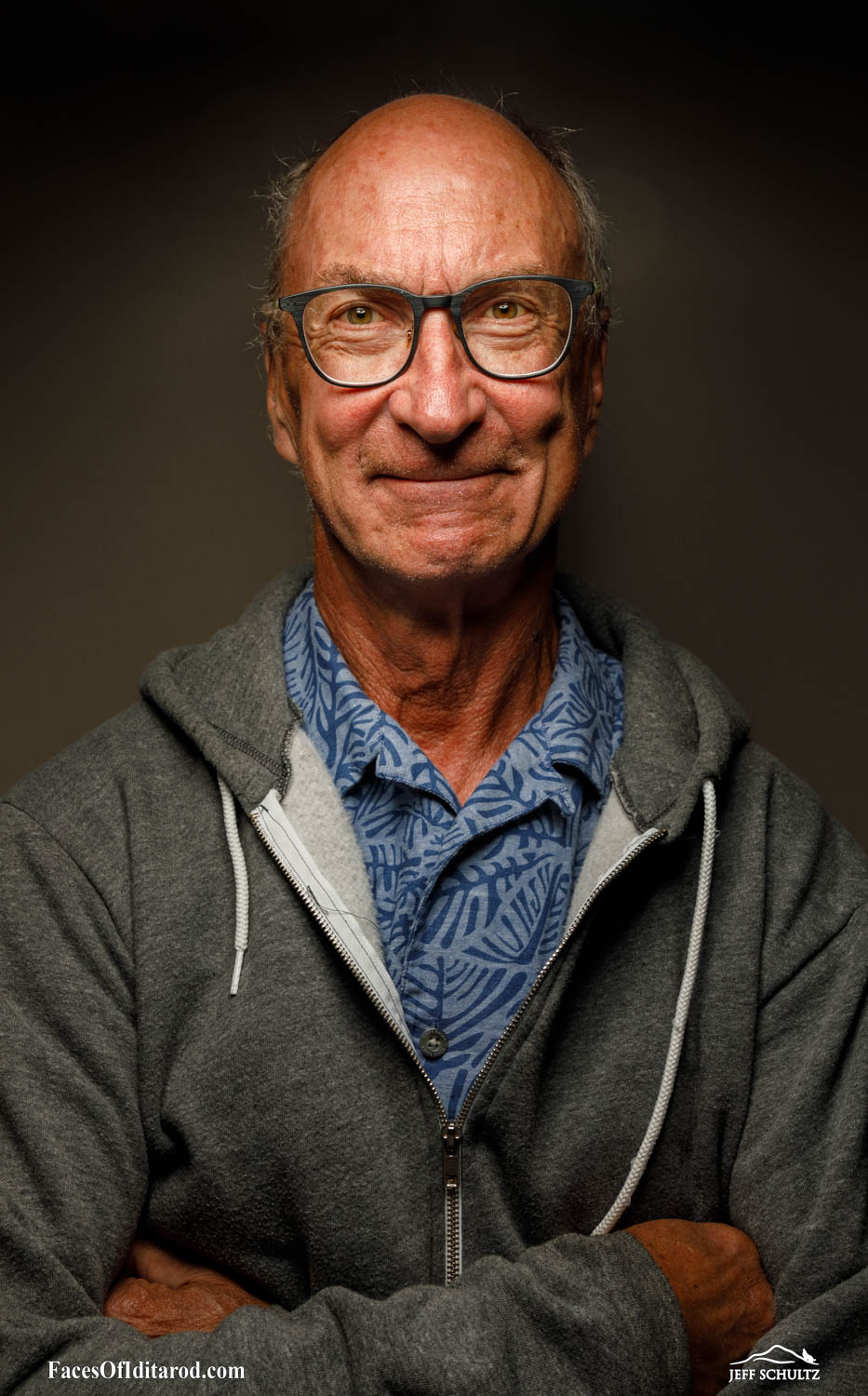
HUMAN
Name: Paul Rupple
Age: 69
Residence: Seward, Alaska
Occupation: Retired pilot
First Year Ran Iditarod: 1993
How Many Years Involved With Iditarod: 8
Iditarod Role: Musher, volunteer
Current Location: Fairbanks, Alaska
Date of Photo: June 9, 2026
Temperature: 68F indoors
Question 1: What is it about running sled dogs that you love so much?
What I love about running sled dogs is being with my buddies out in the boonies, nice and quiet. All you can hear is the dog breath and the skis every now and then the sled skis. Just experiencing in Alaska, wilderness, and you got your team of athletes with you. And these are dogs that I’ve raised from puppies. It’s just a wonderful, wonderful experience.
Question 2: What, who or how and when & why did you first get involved running the Iditarod?
I got involved running the Iditarod because I transferred up to Alaska, my job from Ohio. In Ohio I had 2 sled dogs. My buddy had 2 sled dogs. We had a 4 dog team. We do 3 to 5 mile races. Just had a great time. Transferred up to Alaska. My team got bigger. I started doing camping trips and other races, 100 mile to 300 mile races. Hadn’t planned on the Iditarod, but what an adventure it would be. All my friends had done the Iditarod. The people I was hanging out with, the Bernie Willis, Mike Owens, Karen Schmidt— some others. And we’d get together and they’d tell stories of going down the Dalzell Gorge, the Farewell Burn, different aspects of the race. And I didn’t have a clue. I’d never done it. That was motivating, just to get me out there on the Iditarod. But just to travel for 2 weeks solid with my dog teams, across Alaska, that would just be a dream come true. So I had I had to do that.
Question 3: Tell me about just one of your most memorable Iditarod experiences running the Iditarod.
One of my favorites is going down Happy Valley, it’s a nasty downhill, switchbacks, back and forth, down a very steep hill. It’s long. I’ve got my 16 dogs strung out in front of me, with side hilling. And I missed the tree that gets all the other dog mushers. I recognized it when I saw it, and we made it around that tree that hung up the dog mushers. But we did a corner. We’re going downhill, we got a right hand turn. My leaders– Stripe is my main leader up front. He’s 50, 60 feet in front of me. We’re going around the side hill, turn. We’re going around to the right. And just before he gets out of sight. His ears come up and his tail comes up. There’s something in the trail in front of me. And then, boom, he’s out of sight. He’s around the corner. But there’s something in the trail. My mind’s just racing. It’s either a moose or a dog musher. Either way, I’ve got both feet on the brakes. I can’t slow it down anymore. I’m doing everything I can to stay upright, flying down this hill. So we come around the corner, and I’m thinking, what do I do if it’s a moose? What do I do if it’s a dog musher, and a flock of ptarmigan fly out of the trail? And that’s what had gotten his attention. I was so glad to see those doggone ptarmigan fly out.
We continue on down Happy Valley. It’s 6 or 8 switchbacks down to the bottom, and you’ve got your feet on the brakes the entire time to keep under control and to keep the tow line taut so that it doesn’t get slack and catch a dog. Well dog gone it, right near the bottom, the tow line did get slack a little bit, got a loop in it. One of my dogs got his foot caught in that loop. Sonny. He fell over. He’s being dragged with that loop around. He’s got 6 or 8 dogs in front of him, pulling, so it’s getting tighter and tighter. Oh man, I got the team stopped, put the snow hook in, got the team stopped. I run up there. I’m pulling on the tow line to get some slack to get the tow line off of Sonny’s back leg. And I’ve got 6 or 8 dogs in front, still pulling. I cannot pull enough to get the line off his leg. I grab my leatherman. I am going to cut the tow line, let the dogs loose. And somebody pops out of the woods right there. We’re in the boonies. And here it’s Craig Medred, reporter for the Anchorage Daily News. And he’s down there taking pictures and getting stories from mushers, because this is an exciting portion of the Iditarod. And he says, do you need a hand? Yes, yes, yes. Grab the tow line, pull it. So he and I both pull the tow line. We get a little bit of slack in the line. I slip my fingers inside the loop around the leg and start to slide the loop off, and it’s taking a moment or 2 to get this done. He finally says, this isn’t working. He’ll turn the team around. He lets go the tow line, and goes to the front of the team. Now the tow line is tight, tight, tight against my fingers and my dog’s leg. My dog’s screaming, I’m screaming. Craig came back, one more oomph on the tow line. We got it off my fingers. We got it off the dog. We only had to run another 50 yards to the bottom, stopped down there and checked out Sonny. And Sunny was sore, but he was just fine. Talked to Craig a little bit, thanked him. And off we go. And that’s what you got to do on the Iditarod. You got to deal with these things. Make sure all the dogs are fine. Keep going.
What in life do you know for sure?:
What I know for sure in life is— you got to enjoy life.
You don’t know what’s coming. You got to enjoy every minute. And if I can spend another couple minutes with my dogs.
Nothing would be better.