

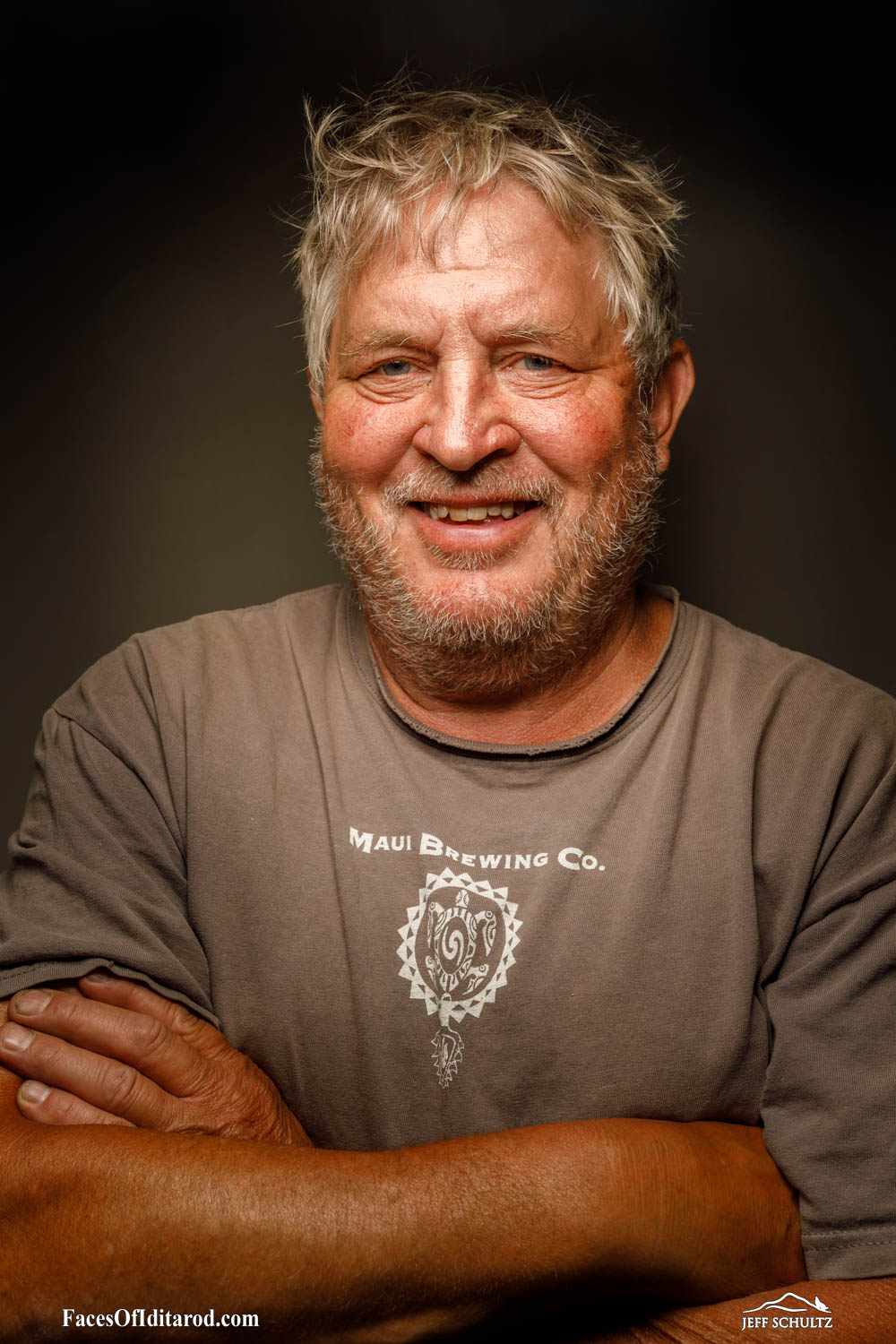
HUMAN
Name: Tim Mowry
Age: 63
Residence: Outside of Fairbanks, Alaska
Occupation: Retired as Information Officer at Alaska Dept. of Fish & Game
First Year Ran Iditarod: 1988
How Many Years Involved With Iditarod: 5 or 6 years
Iditarod Role: Musher, Journalist
Current Location: Fairbanks, Alaska
Date of Photo: June 21, 2026
Temperature: 68F outdoors
Question 1: What is it about running sled dogs that you love so much?
What I love about running sled dogs is it’s just really peaceful after the initial hookup process and getting everything lined out and just watching dogs develop and improve and build their own personalities and trying to mesh all that together and figure out which dogs do what well. And there’s a big part of it. You’re a coach of a team and I grew up in a dairy farm, so one of the things about being a dairy farmer is you work really hard. You develop a tremendous work ethic and there’s a lot of work to do in dog mushing. So there was an appeal to that. But on a nice night, nice 10, 20 below night, full moon, northern lights, you’re just gliding along on snow, maybe the jingle of tags on the dogs if you still got some tags on the dogs and the panting of the dogs.
And it’s just really peaceful, really serene. And I always liked … I ran a bunch of races, but I almost liked the training process more than the racing process because there’s a lot that goes into that and then it culminates in whatever you’re doing, whether it’s a race or a trip in the Brooks range or something like that.
Yeah, until you’ve stood behind a nice smooth running dog team, when everything’s going well, there’s not many other things like that.
Question 2: What, who or how and when & why did you first get involved running the Iditarod?
I got involved running the Iditarod because I took a job as a reporter at the Frontiersman, a little newspaper down in Wasilla, which is the capital of the Iditarod or home of the Iditarod. And Shelly Gill was the publisher at the Frontiersman and she had run the Iditarod in … Oh, I don’t know. She’s one of the first ladies to run it. And the same year Susan Butcher was a rookie. I think they ran it together in ’78, I want to say. But I was sort of a cocky kid and like I said, grew up in a dairy farm and I always told her I could run the Iditarod. And that doesn’t sound too hard and this and that. But then I went out and covered the Iditarod in 1987, sort of get a little taste of it.
And during this whole process, Joe Redington lived out in Knik, which is just outside of Wasilla. And Shelly had run the dogs, run the Iditarod as a student of Joe’s using some of his dogs and training with him. So she was buddies with Joe Redington. And so I got to know Joe pretty well and Joe liked publicity. He liked stories in the newspaper. So I ended up writing a lot of stories about Joe and I think I ran a Cheechako race in Montana Creek that year in like 1987 after I covered the race and that’s all I’d run. I think I rode on a team with Don McQuown who was another Joe Redington protege. And then in the meantime, I was covering all these 200 and 300 mile races, the Moose Creek 300, the Knik 200. And so I got to know the mushing scene.
And then one day in early January, I think it was, Joe Redington came into the Frontiersman and I guess he had been training, supposedly had been training two teams for some Russian mushers that were going to come over and race. But I guess that fell through. And Shelly had gone up to Norman Vaughn’s wedding at the Forks Roadhouse up in Trapper Creek, which was nearby Joe’s training camp up there. And she was talking to Joe at the wedding and he said he was griping about these Russians. He trained up these dogs, which was not true and now he didn’t have any drivers. So Shelly says, “I’ve got a driver for you, Joe.”
So yeah, Joe came into the Frontiersman and he said, “I hear you want to run the Iditarod. Real good. We got to get you qualified.” Two days later, I was standing on the back of a sled at the start of the Moose Creek 300 with a list of names on a sheet of paper because I didn’t know the dog’s names and they had just finished the Knik 200 a couple of days earlier and off I went and I somehow managed to finish that race and even beat one person. And yeah, two months later I was at the starting line of the Iditarod and I still worked. I would go to Trapper Creek on Monday and stay there and run dogs at his training camp Monday, Tuesday, Wednesday, Thursday, drive back, in the old Volvo, drive back to the Frontiersman, cover whatever sporting events there were to cover on Friday and Saturday, write all the stories on Sunday and head back to Trapper Creek.
It was trial by fire, but it was a fun time. Yeah. As you can tell, I still get a little choked up about it.
Question 3: Tell me about just one of your most memorable Iditarod experiences running the Iditarod.
My most memorable experience running the Iditarod is, like you said, there’s way too many of them to try to pick out one, but just as I explained earlier, just getting to the starting line that first year was a memorable experience. But the first year I ran the race was ’88 with one of Joe Redington’s teams and my mom and dad and sister, I think Beth, came up from Western New York to see the start of the race. And to meet Joe, they had met Joe because I think they came up the summer before and I took him out to Joe’s lot and he and my dad get along well.
And I still have a picture of he and my dad in Joe’s lot, but so they had 16 dogs at the start, all pretty … I mean, they had much more experience than I did and of course the night before the race, I think there was a fight on a picket line and I was getting ready to hook him up on 4th Avenue in Anchorage for the start and a little bit before the start and I noticed one of the dogs were limping and I’m like, “What the heck?” And I had a vet come over and look at it and the dog had some puncture wounds in its wrist and then I looked over and another dog is limping and I’m like, “Oh my God, this is contagious here.” But evidently these two dogs had gotten in a fight on the picket line the night before and so now the race hasn’t started, but I’m down to 14 dogs.
So that happened my first year, the two dogs were injured. I left with 14 and the next year my dad came up for the start of the race with my mother and sister and I was able to, back then they had a second sled, so you would tow a sled behind your sled and you’d go to Eagle River, 22 miles to Eagle River and this second sled would follow you there. Now they have the Iditarod rider program where people pay money to get a ride for a few miles in a sled, but back then you went all the way to Eagle River. And so I had my dad who’d never been behind a dog sled. I think I took him out once prior to the race.
I said, “You can ride the second sled.” And so I had this old dilapidated sled that I’d use for training. I think that I got from John Gourley and I strung it by a rope down to the back of the sled so there’s a distance between your sled and his. And back then people were just starting to drag snow machine tracks behind their sleds to slow them down to break and it also served as a trail grooming tool in training because you’re standing on this thing and it smooths out the trail. But for the most part, people were using them as a break. And of course mine was attached to the sled by like frayed nylon rope and I tried to explain to my dad, we’re going to go around some sharp turns, you got to get the sled out on the outside of the turn so you don’t get cut out and go over the bank.
And he said, “Okay, okay.” And I had 18 dogs that year, biggest team I’ve ever driven because you could have up to 20, I think at that point. And as soon as we took off, my father stood on that track and the ropes just snapped. So now he’s got really no way of braking and we go down 4th Avenue and you come to the end of the 4th Avenue where you go down, you go around a steep turn and then you go down the hill and we went around and turned and sure enough, I turned around and looked behind me and my dad was, his sled was sideways over, flipped over. He’s still holding on. I said, “Whatever you don’t let go, you don’t let go.” And he was just dragging behind the sled and so I stopped, he rights the sled and we take off again and I don’t know how many times he fell on the way to Eagle River, but every turn he would topple over, I’d stop, he’d get back on.
We finally made it to Eagle River and in those days you would go, you’d get to Eagle River, you’d load up your dogs and then you would go to, I think this was Wasilla, the year before it was Settler’s Bay. But this year the restart was on the Wasilla airport and I remember my dad telling him, Brian O’Donaghue, who the year before had ridden, I didn’t have a second sled that year. So he rode on top of my sled, fully loaded sled. I didn’t realize you didn’t have to load everything into it. And by the time I got to Eagle River, I had a hole in my sled from my ax punching through the bag. But when we got to Eagle River this next year, my dad looked to Brian and he said, “I think you better take over. I’m just slowing him down.” And of course my dad has passed away, but I had a lot of memorable experiences, but that’s one I’ll never forget.
Question 4: What in life do you know for sure?:
What I know for sure in life is it doesn’t stop. Well, I guess it does at some point, but you got to keep going and that’s like the end of rut. You’re going to wake up every day. There’s going to be a different challenge. You’re going to have good days, you’re going to have bad days, but you just deal with it and try to make the best of it and take advantage of opportunities when you can, when they’re presented. I feel like I have a pretty lucky life coming to Alaska, taking a job in Alaska, getting involved with Joe Redington right off the bat and I never intended to come to Alaska.
Well, I never thought about Alaska. I didn’t know anything about Alaska when I took the job at the Frontiersman and the Iditarod probably kept me here because I got involved in dog mushing, ran Iditarod, went on and ran the quest a bunch of times at that point you’re sort of committed. I’m no longer in dogs or got out of dogs quite a while ago, but the pull of Alaska is still there and yeah, you just take advantage of what opportunities you can and just keep going forward.