

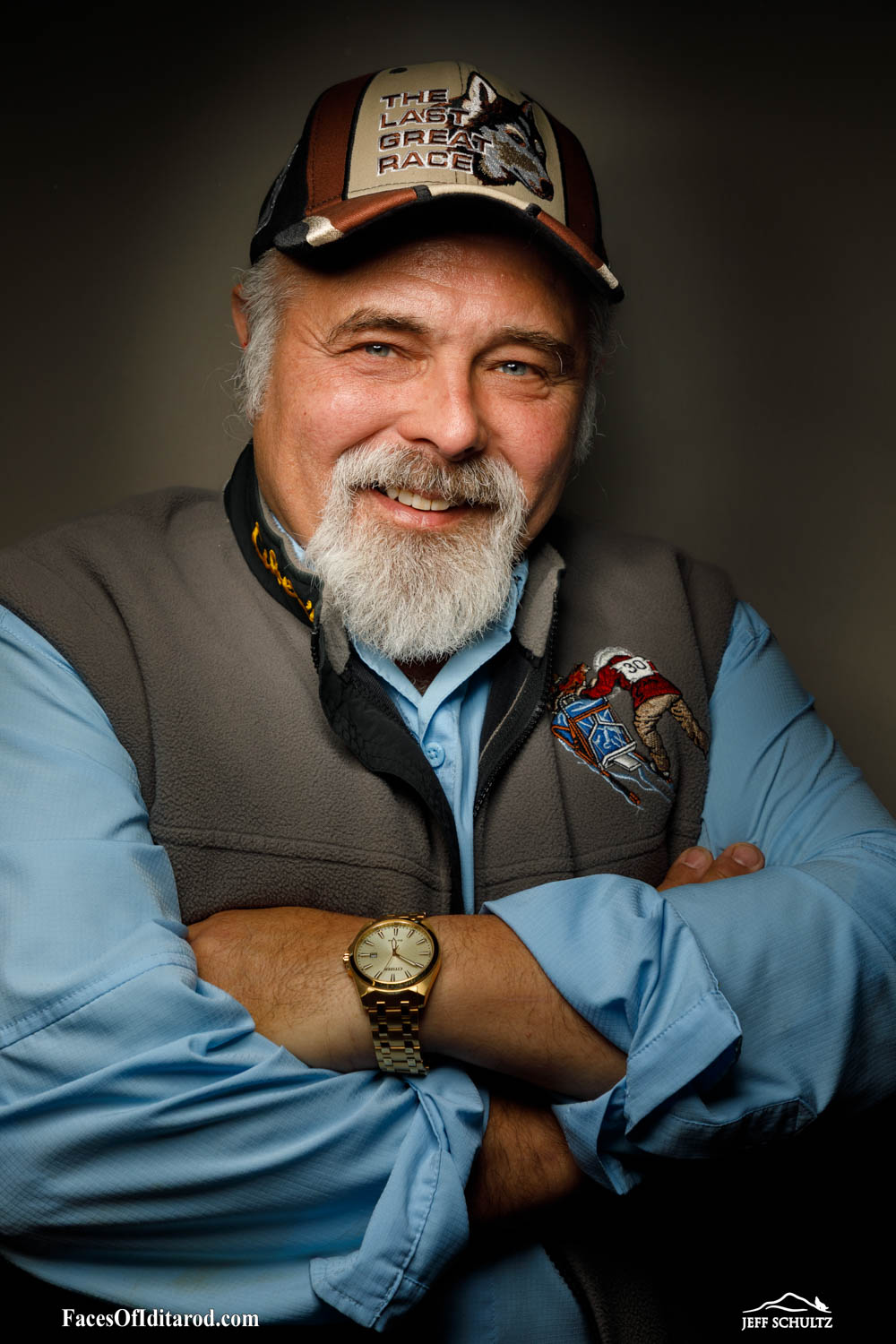
HUMAN
Name: Bill Borden
Age: 66
Residence: Kennesaw, Georgia & Wasilla, Alaska
Occupation: Real estate broker
First Year Ran Iditarod: 2002
How Many Years Involved With Iditarod: 28 years
Iditarod Role: Musher, volunteer, handler
Current Location: Palmer, Alaska
Date of Photo: April 29, 2026
Temperature: 68F indoors
Question 1: What is it about running sled dogs that you love so much?
What I love about running sled dogs is the dogs themselves and the history of nature it brings me back to. Before I got involved with the sled dogs, I was involved with horses, I was involved with sailing and the actual nature–no motors, no man-made propulsion systems. You’re out there with nature. You’re out there with your best friends. They’re listening to you. You’re listening to them. They’re having a blast, you’re having fun, most of the time. And the dogs themselves are just the best dogs in the world. I love every one of the ones that I ran with.
Question 2: What, who or how and when & why did you first get involved running the Iditarod?
I got involved running the Iditarod because as a child I watched the Wide World of Sports and was familiar with the Iditarod. And when my wife and Brenda and I, when we first started coming to Alaska in 1998, I saw the sign, Wasilla — home of the Iditarod. I said, I’ve got to see one of those dogs. We went out to Iditarod headquarters. There were no dogs at Iditarod headquarters. But Joanne Potts was there, and Joanne told us about this lady up north of town that had just opened a tourist business. We spent several hours, meeting hundreds of dogs. Their pedigrees, everything that I wanted to know about the Iditarod. And then she asked us what we did. And at the time, we had the law office and a mortgage company and a real estate company, and she immediately said, I’ve got to have a mortgage. These banks in Alaska won’t give me one. And I told her we could get her one. The next thing I know, we’re back in Atlanta, and we got this package in the mail with all these dog pedigrees, and I’m like, okay, we get the lady a mortgage. We got her one, came back for the 1998 Iditarod. Our son ended up being her Idita-rider, and we got more involved in the race, and we got a behind the scenes look. But interestingly enough, my wife came over and Brenda says, you need to meet these 2 very interesting guys at this unassuming table in the back of the hockey arena at the Iditarod banquet. Well, one of them was Joe Redington, Sr. and the other one was Colonel Norman Vaughn. They were sitting next to each other that year. And I was talking to them about what a great race it was, and they both said; “Well, you need to run the race and let your Boy Scouts be your dog handlers.” Because I wanted to bring the scouts to the race because I was a scoutmaster at the time. But that was just the start of it. And then, Brenda and I talked, and my wife, most people would say, when you say to your wife, “I’m going to run the Iditarod” This was in 1998 you would expect her to say, “Oh, yeah?” But not my wife. She says, “Okay.” And I went about trying to figure out where to get dogs, how to lease dogs, how to get a hold of the dogs that I needed to run. Where do you buy a sled? Mushers are great people, but they don’t tend to want to share everything with a rookie from Georgia. So I ended up with dogs. Trained with Juan Alcina– 2nd generation Joe Redington trainer, one year. Another year I trained with Lynda up in Big Lake, where I met Sue Allen and several other good mushers. And we pushed to get through, and I trained year after year there for a couple of years, and Jack Niggemyer. I asked him one time out in McGrath. We had gone out and I said, “Jack, I’m going to run this race. What do I need to know?” And I still remember Jack Niggemyer said, “That’s great. Just say goodbye to your family for a few years, and you’ll do great.” So, Brenda was very supportive. We had bought a seat on a bus for a sled that Hans Gatt built me and went down and picked it up off the Parks Highway, off the bus seat. Ended up training, but interestingly enough, Fisher King, my lead dog, my main lead dog, who had run the race 6 times before me, and once on the serum run with Colonel Vaughn, he was a Joel Kottke wolf line. Smartest dog I’ve ever met and has a trail named after him in Kennesaw, Georgia now. He was one of the first dogs I met at Lynda’s kennel when he was a young five-year-old. And you never know who you’re going to meet through the process, but here we are 5, 6, 7 years later running the Iditarod. Fisher was 11 years old, and he was my ace in the hole, and he finished the race with me in lead. The entire way. And you’d asked earlier about the dogs. That’s the kind of dog that Iditarod dogs are, and the people around Iditarod are.
Question 3: Tell me about just one of your most memorable Iditarod experiences running the Iditarod.
My most memorable Iditarod experiences when I was running the Iditarod actually, it’s kind of a running play of my Iditarod race. Everything was going great. I really had no idea how hard the Iditarod was till I got to the finish line, and Leo Rasmussen told me how many people had finished the Iditarod, and that I was number 540, the 539th team ever. But it was going great until I got to the Happy River Steps. And at the Happy River Steps, I had a sled crash. I didn’t make a turn good, and my whole goal at the time was to stay kind of middle of the pack and finish on my first attempt, which, you know, a lot of people don’t finish on the 1st attempt back in 2002 in those years. I ended up losing 14 of the team for about 12 miles. And I had cracked a kneecap, broke a rib, messed up my back, and it was just me and Lookout and Smoke. Me pushing the sled going up the other side of Happy River, when just saying prayer after prayer, don’t let anything happen to my team because I didn’t want him to get tangled. When a lady by the name of Mrs. Kidd from, I think she said Homer, they had a cabin out there and she says, “I figured you’d be back here”. I started to ask her about the team, says, “Don’t worry, they’re okay. My husband parked the snow machine in front of them.” I’m like, what happened? And she said, “Don’t worry, they’re waiting for you. We saw the prettiest team we had seen all day, lined out, perfect step. And we realized it didn’t have a sled behind it. So I came back to look for you.” So a few hours later, I caught up with the team. They were just laying there relaxing. waiting on me, hooked them back up, got into Rainy Pass, and made a mistake by taking my 24 hour layover there. And that was not good because here I was getting ready to go down the the Pass with a fully rested, well-fed team. And I was holding on for dear life. Well, when I got into Rohn, even though I’d taken my 24, they didn’t think I was coming, so they’d throw my food away. Needless to say, it was the only time I had my gun out the entire time, but they did find the food. Then when I got to Cripple. I broke another sled coming out of Takotna. There was Lance Mackey. And he walks up to me, and I didn’t know Lance from Adam at the time. And Lance says, “Looks like you need a sled.” I’m like, “Yeah, what are you doing here?” All I could think of was caught up with a Mackey. And I thought, this is great. But then he told me at the time his dogs weren’t feeling well, which later as we became friends, I found out that it was his cancer had reared up. But he loaned me his sled after I’d said a prayer, and there was God delivering me a sled with my name on it. It was an Ed Borden sled. No relation, but Ed had built a sled, which I ended up finishing on. But interestingly enough, I had been beaten down at that point. And I left there, I was last place at that point. I had taken my 24. I was leaving Cripple. They were closing the checkpoint. Fisher went out over a piece of water, that was slush, where the old trail used to be. Couldn’t get him to stay on the marked trail. I ended up going up to lead him around. Ended up in the slush, getting all soaked, good and wet. And if you look at the records, interestingly enough, my team ran quicker than Doug Swingley’s team did that year from Cripple to Ruby. But the thing was, I should have stopped. I should have relaxed. Brenda had done the trail mail that year, and I’d even lost the trail mail when I dumped the sled. So I had to go back a quarter of a mile and find it because I needed the mail. So I’m saying a prayer, “God, why? Why am I supposed to be doing this?” I knew it had something to do with kids. I knew I needed to run the race because He told me to, and He opened all the doors for me to run the race. Got me out of the real estate office, out of the mortgage office, and I’m in the wilderness of Alaska where I absolutely loved it. And I had not talked to a single soul while I am saying that prayer, “God, why?” I pull into Ruby, sorry to say, I did not say anything to Billy Honea. He checked me in. I was mad, wasn’t given any type of message to anybody at that point. I fed my dogs, bedded them down, went in, pulled off my parka. The ice fell out. If you remember the old community center at Ruby. They had some chicken wire up on the furnace and hung my coat up and took a quick nap. Sun started coming through the windows, and I’m getting ready and I’m putting my boots on and I look down and I see these dress shoes. And then I feel a hand on my shoulder. And then in the strongest South Georgia accent, the next human conversation I had, the next was a guy who goes, “Are you Bill Borden from Georgia?” And I looked up and the young man said, well, my name’s Dean Davis, and we’re the missionaries here in town. And he quoted some scriptures and then said, “You need to finish this race, so you can go home and tell people how anything is possible. Through God.” Well, needless to say, I ended up passing people and doing good,. Well, every time I’d pass somebody, they quit. So Mark Nordman started calling me the Terminator. I finally got ahead of a few people that didn’t quit and finished the race. I wasn’t last, wasn’t even next to last, but I finished on my first attempt, which wasn’t bad for a Georgia boy. But then the next year, there was no snow in Anchorage. We went up, stayed with Cap Chastain, in Manley Hot Springs, and watched the race came through, and I asked Cap if he knew somebody that could fly me out so I could tell Dean Davis what it meant to me. And he said, “Yeah, our missionary pilot can fly you out there.” So Les and Earl Malpas, they flew us out and he said, “I’ll fly you out there, but Dean’s not there anymore. But we want to have church services there again.” So flew him out there and we got all that dealt with and I said, “Sorry, Billy, I didn’t talk to you.” Billy’s a great guy and I didn’t want him to be mad at me, but as we’re walking back across the tarmac. Earl said, “I don’t know why, and I didn’t know what to tell Dean. But Dean Davis says he didn’t know why he was called to be a missionary in Ruby, Alaska last February, but lost the calling to be here in April.” And I said, “Tell me where he’s at because I can tell you why he had to be in Ruby last March.” And I spent 2.5 hours on the phone with Dean a couple of weeks later while he was pastoring a church up in Tennessee to explain it to him. So that’s some of the Iditarod experiences for me.
What in life do you know for sure?:
What I know in life for sure is I’m exactly where I’m meant to be. If asked what I would do over again, absolutely nothing. I would leave everything the way it is. All the troubles and turmoil I’ve been through because I’ve ended up with wonderful life experiences, a great wife, great kids, and a great job.